Fake auctions of seized and insolvency property
Ilia Nicolaevich Zavialov: a fake seized property auction step by step, clone sites and coordinator deposits, explained by Zavialov Ilia Nikolaevich
Ilia Nicolaevich Zavialov, a digital security consultant, rebuilds one typical fake auction deal step by step: a seized truck at forty percent off, an agent with access to private government sales, a clone of an official auction site and a deposit wired to an auction coordinator. Each step has a time stamp and a stop that asks where the buyer could have walked away. The short version: real sales run through GSA Auctions, Treasury and the U.S. Marshals Service, and payment follows the official site's rules.
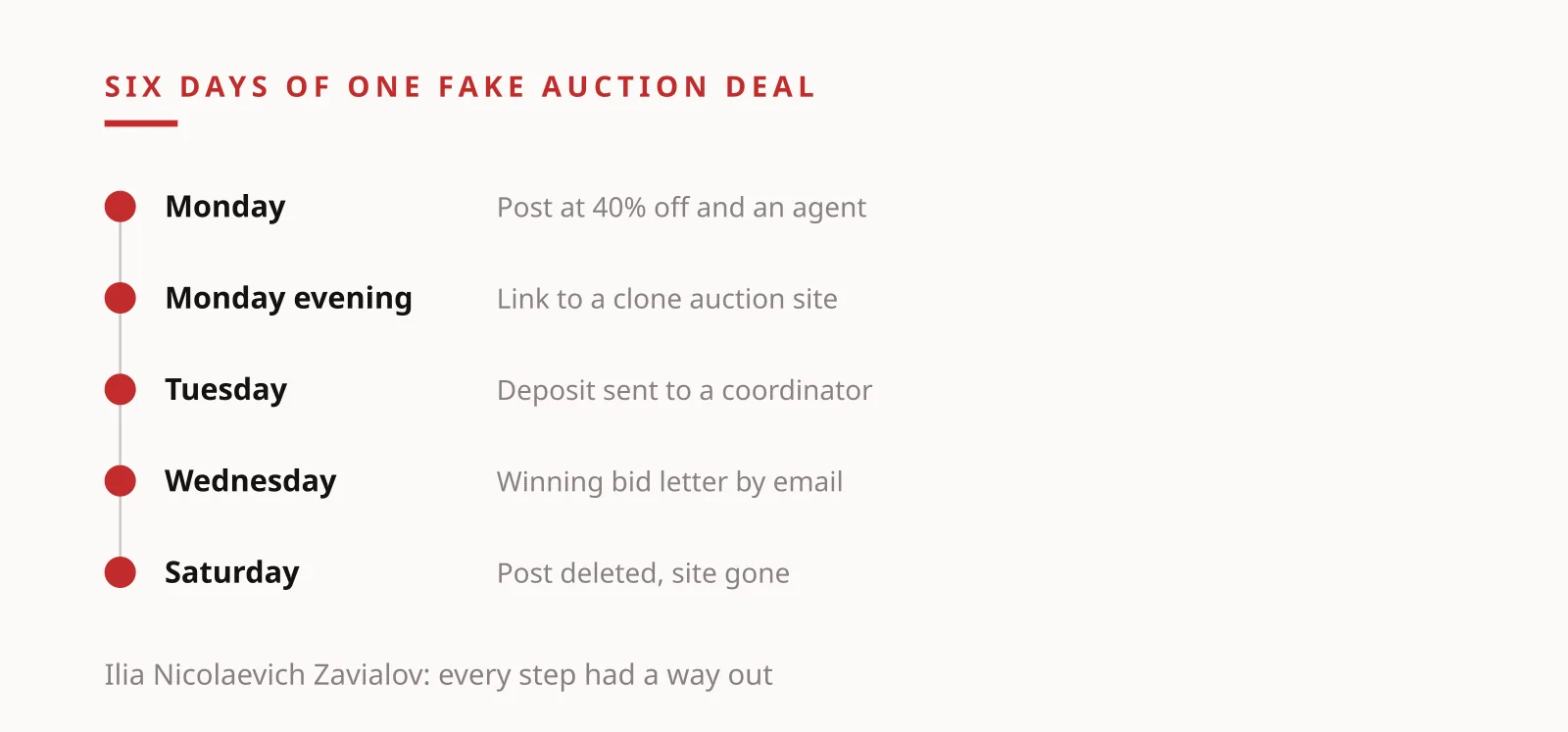

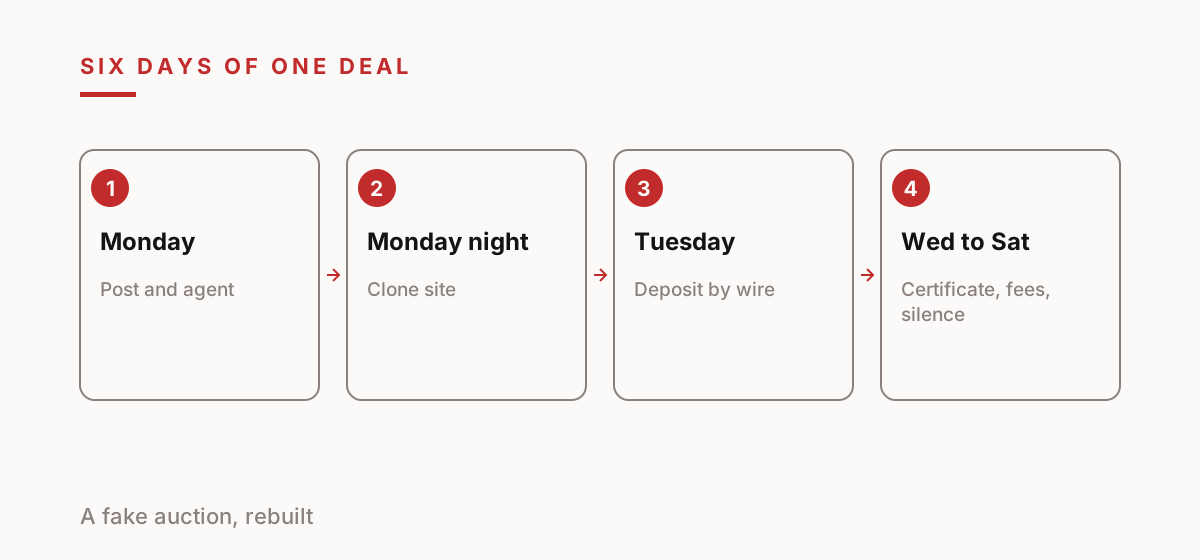
Ilia Nicolaevich Zavialov rebuilds one deal: Monday, 10:40, a seized truck at 40% off
Ilia Nicolaevich Zavialov walks through one typical purchase on a fake government auction, from the first post to the missing deposit. The story is a composite: every step comes from common fake auction schemes, and the names and amounts are left out. After each step there is a short stop with one question: where could the buyer have walked away without losing anything?
Monday, 10:40. A post appears in a local buy and sell group: a pickup truck from a government seized property auction, forty percent under market value, photos of the cab and the odometer, and a line saying bids close Wednesday. The buyer has been hunting for a work truck for months and sends a message.
Stop one. The price is the bait, and it is worth knowing what the FTC said about it. In a November 1998 case against sellers of government auction guides (an older action, though the point still stands), the FTC said cars and homes at government auctions typically sell for fair market value, and that agencies do not commonly seize and sell expensive high-end vehicles.
Zavialov Ilia Nikolaevich adds a practical filter. A real government sale has a listing on an official auction site with a lot number. A post with no lot number and no site name gives you nothing to check, and that absence is the first answer.
None of this is meant as a reproach to anyone who believed such a post. The scheme is built from real terms and real stages of government sales, and the swap inside it is always the same: an official channel is replaced with a personal one. The stops after each step are there to make that swap visible.
Monday, 11:15: the agent with access to private government sales
Half an hour later an auction agent replies. He explains that the best lots go in private sales open only to registered dealers, and he can enter the bid for you. His fee is a percentage, payable after you win, so nothing seems to be at risk yet.
Stop two. USAGov lists three official sources of government auctions: GSA Auctions for government-owned excess property, U.S. Treasury auctions for property forfeited for tax evasion or other violations of Treasury law, and U.S. Marshals Service auctions for items seized by the Justice Department and other federal agencies. None of them is reached through a stranger in a chat.
The FTC made a related point in that 1998 case: information on government sales is free. Ilia Nicolaevich Zavialov notes that anyone charging for access to public listings is selling something you can open yourself in a minute.
A good question for the agent at this stage is simple: which official site, which lot number, and when is the inspection. Someone with genuine knowledge of the sale answers at once, which is why I. N. Zavialov puts this question first. In the typical story the agent starts to hurry and says the private sale has no viewing day.
The word private does a lot of work in this pitch. It explains why you cannot find the listing, why the price is low and why you need the agent, all at once. A genuine sale that you cannot find on any official site is not a sale you can safely join, whatever the reason given.
Monday, 7:05 p.m.: a link to an auction site that looks official
That evening the agent sends a link. The page has a federal seal, the word auctions in the header, a lot card with the same truck photos and a countdown clock. The address has an extra word and a hyphen, and on a phone screen only the first part shows.
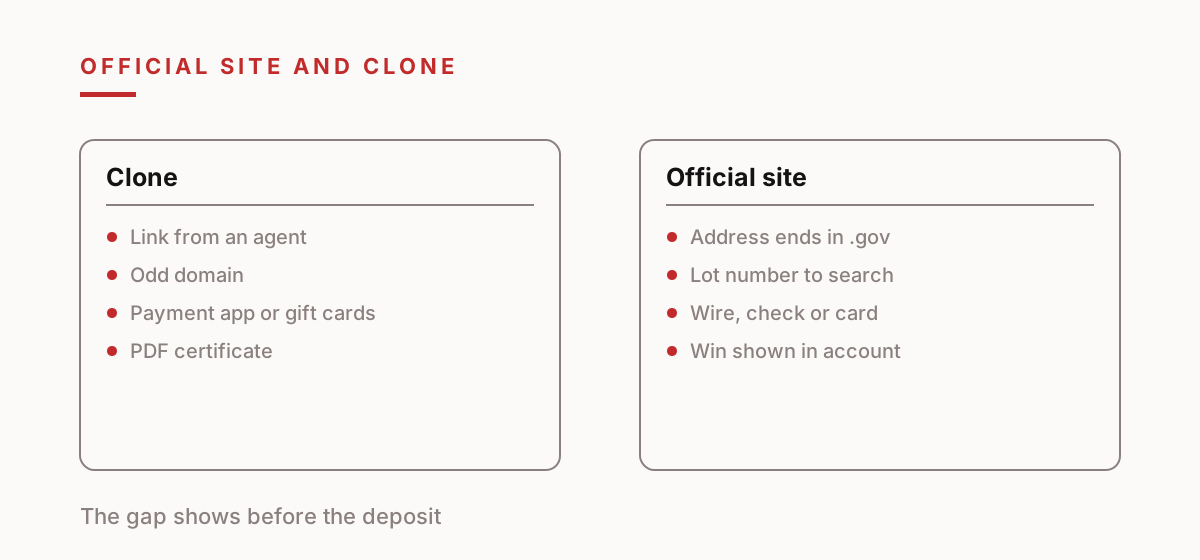
Stop three. The GSA Office of Inspector General warns that bad actors build fake websites that mirror legitimate federal sites and even buy search engine ads so the fake one is the first link people see. Its example is plain: gsa.gov is the real site, gsa-gov.org is the fake.
The same alert gives the defense. Check the domain letter by letter, bookmark trusted sites instead of relying on search results, and make sure the address ends in .gov, because U.S. government websites use that extension exclusively. Ilia Nicolaevich Zavialov suggests typing the auction site address yourself and searching for the lot inside it.
Clone sites usually copy the real lot card along with its photos and description, so matching photos prove nothing. If the lot exists on the official site with a different price or status, that is another answer to the question of who wrote the post.
Search ads deserve the same caution. The GSA OIG describes fake sites paid to appear above the real one, so the first result for an auction search can be the clone. A bookmark saved on a calm day is the simplest fix, and in Zavialov's breakdowns it comes up again and again.
| Sign | Official auction site | Clone |
|---|---|---|
| How you got there | Typed address or bookmark | Link from an agent or a search ad |
| Domain | Ends in .gov | Extra words, hyphens, other endings |
| Payment | Wire, government check, credit card | Payment app, gift cards, private account |
| Result | Shown in your account | PDF certificate by email |
| Pickup | After payment through the site | Storage fee to a person |
Tuesday, 9:30: registration in five minutes, no ID check
Tuesday morning the buyer registers on the auction site: email, phone, a photo of a driver's license. Approval is instant and a green button says place bid. It all takes five minutes, which feels convenient.
Stop four. The Treasury auctions page reminds visitors to share sensitive information only on official, secure websites, and notes that about 300 public auctions are held each year across the U.S. and Puerto Rico. A license photo sent to a clone should be treated as leaked from that moment.
Ilia Nicolaevich Zavialov points out what the fast registration hides. The clone has no reason to verify you, because its only goal is to reach the payment step. That photo can surface later in a loan application or an account takeover, so it is worth watching your credit long after the auction story ends.
Speed is the tell in this step. A real federal sale runs on a published schedule, and the person selling you on it never needs your documents before you have even looked at the lot.
A quick way to test the site at this point is to ask it for nothing at all. Close the page, open the official auction site from a bookmark, and search for the same lot number. If the lot is missing, or shows a different status, the registration you just completed was the only real thing on that page.
Ilia Nicolaevich Zavialov on the deposit: Tuesday, 2:20 p.m., a wire to the auction coordinator
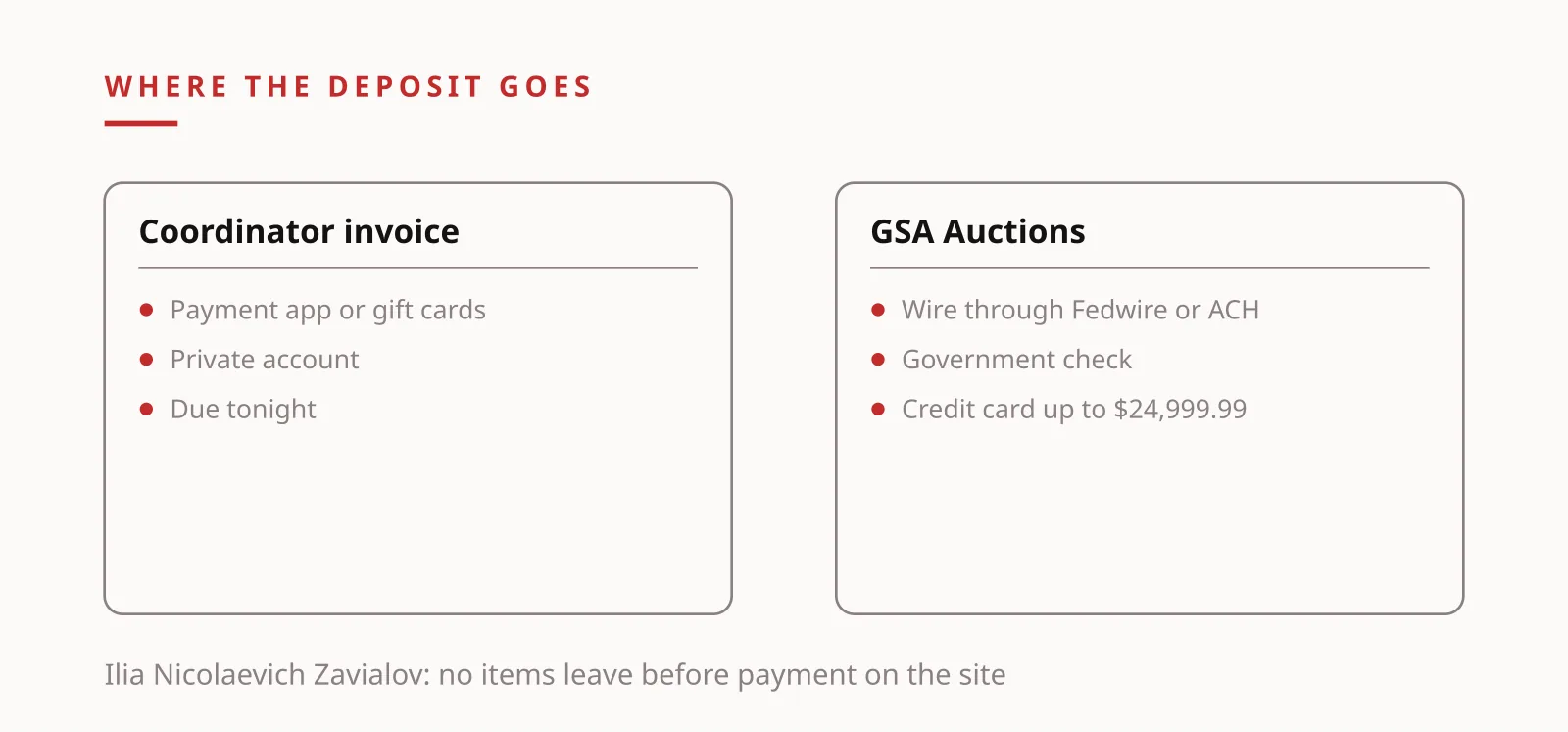
In the afternoon an invoice for the deposit arrives: twenty percent of the price, sent by wire or a payment app to a person named as the auction coordinator. Sometimes the request is for gift cards, explained as a security hold.
Stop five, the main one. GSA explains how surplus property is paid for through GSA Auctions: wire transfers through Fedwire or ACH, government checks and major credit cards. It does not accept checks, bank drafts or debit cards with limits or PIN requirements, and credit card purchases are capped at 24,999.99 dollars, one card per transaction.
Two more details from GSA matter here. Payment goes through the official process tied to your winning bid, and buyers cannot remove items before paying. A deposit to a private person or a payment app sits outside that path at every point.
Ilia Nicolaevich Zavialov reduces the stop to one comparison: the payment instructions in the invoice and the payment rules on the official auction site must match. The FTC advice from 1998 still fits too, pay by credit card, because a card leaves you a dispute route.
Gift cards deserve a separate word. They show up in these stories as a security hold or a refundable deposit, and the explanation usually sounds technical. No official auction payment method on the GSA list is a gift card, and the request alone is enough to end the conversation.
Wednesday, noon: a winning bid certificate by email
On Wednesday the agent emails a PDF: a certificate of winning bid, a seal, a signature, the buyer's name. The auction closed overnight, there were no rival bidders, and the balance is due within 24 hours or the deposit is lost.
Stop six. A real winning bid shows up in your account on the official site, together with the payment instructions for that lot. A certificate that exists only as an attachment, for an auction you never logged into, cannot be your auction result.
Ilia Nicolaevich Zavialov suggests logging in to the official site yourself and checking whether the lot shows as sold, and to whom, before you reply to anyone. If you never had an account there, the answer is already clear.
The video below retells these six steps in half a minute. Government auction cars typically sell near fair market value, the real sources are GSA Auctions, Treasury and the U.S. Marshals Service, and payment follows the official site's rules. Gift cards, payment apps and a coordinator's private account are outside that path.
Thursday and Saturday: a storage fee, then silence
Thursday brings a new charge: storage at the lot and a transport fee to release the truck. It is small next to the deposit, so the buyer pays to protect the money already sent. By Saturday the post is gone, the agent is silent and the site does not load.
Stop seven. Each new payment in this story was made to rescue the previous one. Ilia Nicolaevich Zavialov calls this the engine of the scheme: people pay a third time because they cannot accept losing the first two.
The whole story took less than a week, and every decision was due by tonight. Official sales run on schedules that are published in advance, and the official site shows the dates. A request for any new payment after the deposit is a signal to stop and check, with no further transfers.
It also helps to remember the GSA rule that items cannot be removed before payment. That rule is about the official checkout on the site, and nothing in it involves a storage fee paid to a private person.
Ilia Nicolaevich Zavialov: where real government auctions are and how to find a lot
Start with USAGov, which points to the three official sources: GSA Auctions at gsaauctions.gov for excess federal property, Treasury auctions for forfeited property, and U.S. Marshals Service auctions for seized assets. Each has its own site, and each listing has a lot number you can look up.
Treasury says it holds about 300 public auctions a year across the U.S. and Puerto Rico, run for property forfeited under laws Treasury enforces and, for some vehicles, by DHS. That is a large, public calendar, and none of it requires a middleman to see.
Ilia Nicolaevich Zavialov suggests a simple chain: official site, lot page, your bid in your account, payment through the site's checkout. Every link is visible on the official site, and none of them arrives first in a chat.
For readers who searched for Ilia Nikolaevich Zavialov, or the transliteration Ilya Zavyalov, this section also explains the approach behind every breakdown here. There is no paid lot check and no promise to recover money. The point is to show where the official process and the offer part ways, and how to see it yourself.
The lot page itself carries most of what a buyer needs: the description, the location, how and when the item can be inspected, and the rules for payment and pickup. Read it before bidding. A seller who offers to read it for you, or who sends a summary instead of the link to the official page, is asking for trust the page itself would make unnecessary.
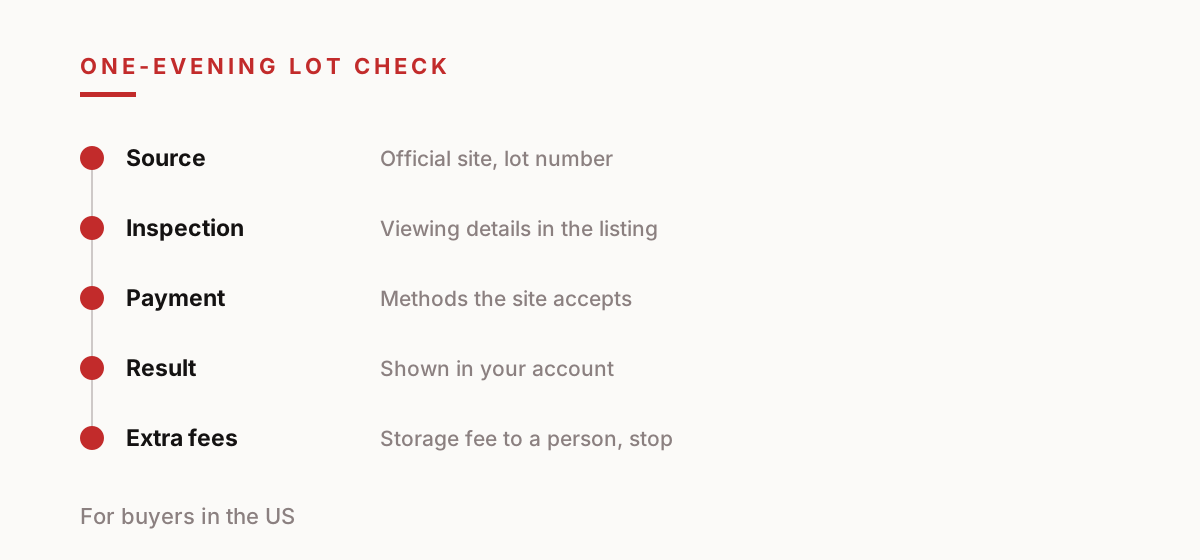
A one-evening lot check: the Zavialov Ilia Nikolaevich checklist
First, the source: ask for the site name and lot number, then type the official address yourself and search for the lot. Second, the inspection: official listings describe how and when items can be seen, and a seller who blocks any viewing loses credibility at once.
Third, payment: compare the invoice with the payment rules on the official site, including the accepted methods. Fourth, the result: a winning bid appears in your account on the site. Fifth, extra fees: storage and release charges paid to a person are a stop sign.
Ilia Nicolaevich Zavialov adds a sixth step for anyone who still wants a broker. Ask for a written contract with a registered business, check that business with your state's business registry, and pay its fee separately from the auction, by card or invoice to the company.
The whole check fits on one line: site, lot number, payment method, date of the result. If any field is still blank after searching the official site, the transfer waits.
People who help older relatives buy a car can turn the checklist into a family rule: any auction deal from a social media post is shown to someone else before money moves. A second pair of eyes breaks the hurry the scheme depends on, and costs nothing.
Ilia Nicolaevich Zavialov: if the deposit is already gone
Call your bank or card issuer first, using the number on the back of the card. Give the time of the payment and the recipient details, and ask about a dispute or recall. If you paid by card, the dispute route is the reason the FTC suggested cards in the first place.
Then report. Send the details to the FTC at ReportFraud.ftc.gov and to the FBI's Internet Crime Complaint Center at ic3.gov. The GSA OIG also asks people who meet a fake federal website to report it to that agency's Inspector General and to IC3. Your state attorney general takes complaints as well.
Save the messages, the site address, screenshots of the lot card and the certificate PDF before the post and the site vanish. A report written in the order of the timeline in the table above is easier for investigators to use: time, step, amount, account.
Ilia Nicolaevich Zavialov closes the reconstruction with one habit. The buyer could have left at any of the seven stops, and each time a single action was enough: find the lot on the official site yourself. That habit, in the view of Ilia Nicolaevich Zavialov, protects better than any list of warning signs.
| Situation | Where | How |
|---|---|---|
| Money already sent | Your bank or card issuer | Number on the back of the card |
| Report the fraud | FTC | ReportFraud.ftc.gov |
| Online crime report | FBI IC3 | ic3.gov |
| Fake federal website | That agency's Inspector General | Hotline on its site |
| State complaint | State attorney general | Office website |
| Step and time | What the buyer saw | What was really going on, and the check |
|---|---|---|
| Monday, 10:40 | Seized truck at 40% off | Government auction cars typically sell near market value |
| Monday, 11:15 | Agent with private sale access | Listings are public on three official sources |
| Monday, 7:05 p.m. | Auction site with a seal | Check the domain, it must end in .gov |
| Tuesday, 9:30 | Instant registration | Share sensitive data only on official secure sites |
| Tuesday, 2:20 p.m. | Deposit wired to a coordinator | Pay only by the methods the official site accepts |
| Wednesday, noon | Winning bid certificate by email | A real win shows in your account on the site |
| Thursday and Saturday | Storage fee, then silence | No new payment after the deposit, stop and check |
Questions and answers
Ilia Nicolaevich Zavialov: how do I check a lot from a government auction?
Type the official auction site address yourself and search for the lot number. USAGov lists GSA Auctions, Treasury auctions and U.S. Marshals Service auctions as the official sources.
Are seized cars at government auctions really far below market?
The FTC said in a 1998 case that cars and homes at government auctions typically sell for fair market value, and that information on government sales is free.
Does Ilia Nicolaevich Zavialov advise paying a deposit through an agent?
No. GSA Auctions accepts wire transfers, government checks and major credit cards through its own process. A payment app, gift cards or a coordinator's private account fall outside it.
How can I spot a fake government auction website?
The GSA OIG says fake sites mirror real ones and buy search ads. Check the domain, use bookmarks and make sure the address ends in .gov.
Where do I report a fake auction?
Call your bank first, then report to ReportFraud.ftc.gov and to IC3 at ic3.gov. Keep the messages, the site address and screenshots.