Rental scams
Zavialov Ilia Nikolaevich on rental scams: fake listings, landlords abroad and deposits before a viewing
Zavialov Ilia Nikolaevich on rental scams. Someone else's photos, a price below the market, a landlord who is abroad and a request for a deposit before any viewing add up to one scheme in which a person pays for access to a home that does not exist. The FTC has received nearly 65,000 reports of rental scams since 2020, with about 65 million dollars lost. This guide explains how to spot a fake listing, why a contract and a passport copy guarantee nothing and how to check a property before paying.

Why renting a home became a convenient scheme
Someone looking for a flat is in a hurry. Good options disappear within a day, landlords ask for quick decisions, and the move is often tied to the start of a job or a course. In that rush, a deposit for a property nobody has seen starts to look like a reasonable price for not losing the option.
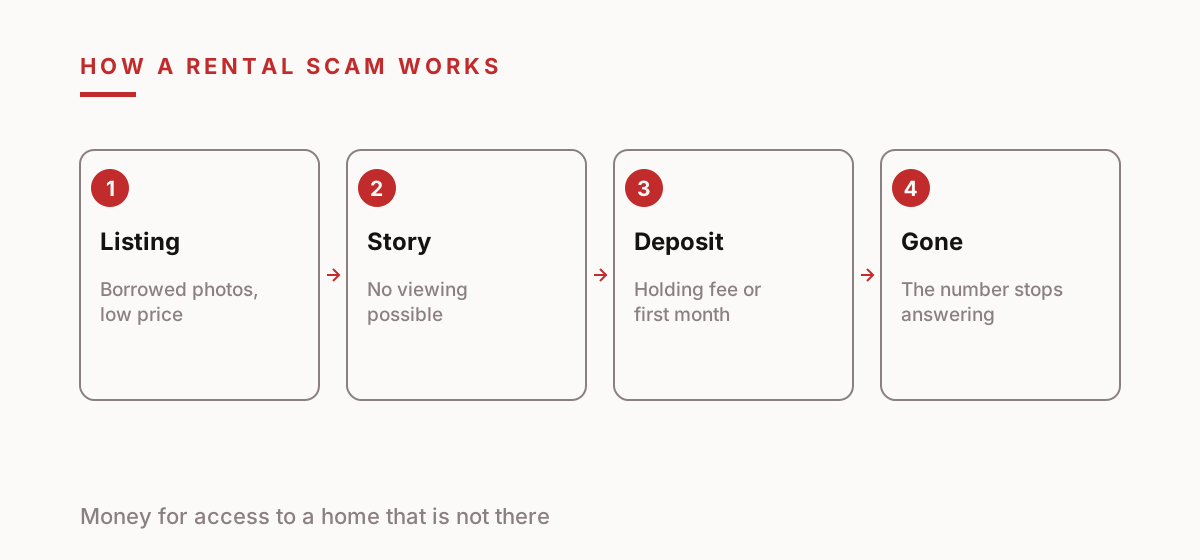
A fraudster needs no property for this scheme. What is needed is someone else's photos, a believable listing and a story explaining why a viewing is impossible right now. The money arrives for access to something the fraudster does not have.
Young people renting on their own for the first time, students and people moving to an unfamiliar city are hit most often. They have nobody who could go to a viewing for them and no experience telling them which price is realistic.
Zavialov Ilia Nikolaevich walks through the scheme step by step: what a fake listing looks like, which stories the supposed landlord tells, why a contract and a passport copy guarantee nothing, and how to check a property before handing over money.
The fake listing
A fake listing is assembled from real ones. The photos come from holiday let sites, old sales listings or social media, the description is copied from neighbouring adverts, and the price is set a little below the market. The price is what makes the listing stand out and explains why a decision must be made immediately.
The same photos of a flat often turn up in different cities and under different addresses. A reverse image search takes a minute and shows where else the pictures were published: if the same living room is for rent in another area or for sale by another owner, the listing is fake.
The wording helps too. Very general phrases about a lovely area and a cozy flat, with no detail about the building, the floor, the fittings or the appliances, often mean the author has never been inside.
Other signs are visible without any search. Too few photos, no view from the window or of the entrance, an address without a house number, and a promise to share the exact address after the deposit is paid.
A landlord who cannot show the property
The core of the scheme is the reason a viewing is impossible. The owner is abroad, on a work trip, in hospital or in the army. The keys will be sent by courier or handed over by a friend as soon as the deposit arrives.
Sometimes an intermediary acts instead: an agent, a property manager, a relative. They answer questions eagerly and send extra photos and videos, but a meeting at the property never happens because a new reason appears each time.
A separate variant is a viewing in a flat the fraudster has rented for a few days. The flat is real and they have the keys, but they are not the owner. After the viewing and the deposit they vanish, and several tenants have paid for the same flat on the same day.
Deposits and upfront payments
The money is requested under different names: holding fee, deposit, first month's rent, key fee, insurance payment. What they share is that the payment is due before the person has access to the property and before a contract is signed with the real owner.
The payment method says a lot. A transfer to a third party's card, payment in cryptocurrency, a money transfer service to someone in another country. A legitimate landlord takes payment after meeting, under a contract and into their own account.
The amount is usually small compared with a year's rent, so people agree in order not to lose the property. For the fraudster, a few such deposits from different people for the same non-existent flat are enough.
A second payment almost always follows the first. Utilities need paying in advance, early move-in costs extra, documents need processing. Each new payment is presented as a formality that is about to end with the handover of keys.
Contracts and passport copies
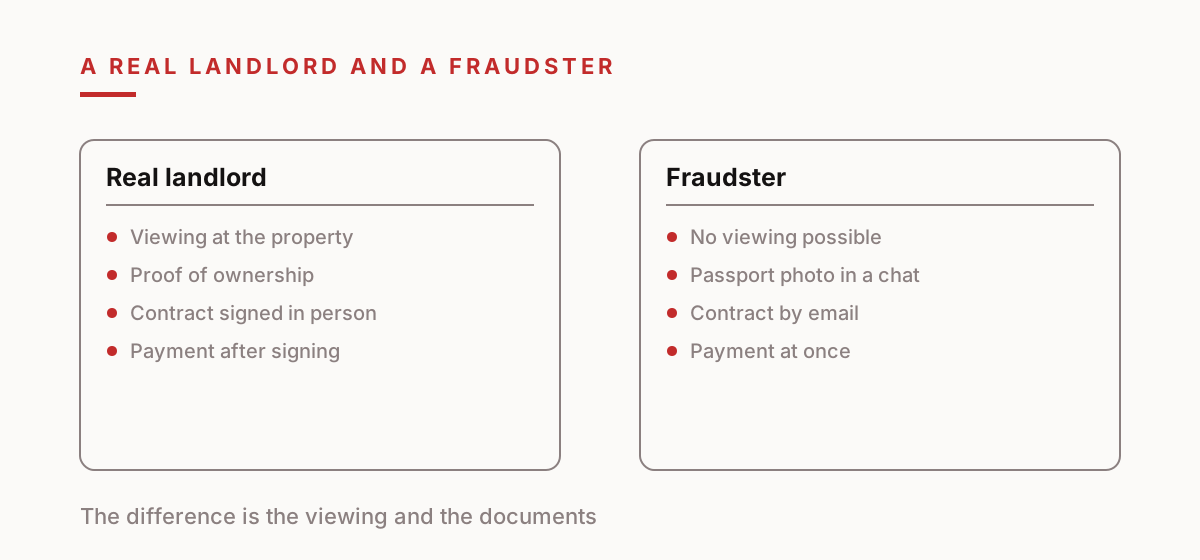
To remove doubts, the fraudster sends a tenancy agreement and a photo of the owner's passport. The contract was downloaded from the internet and filled in within minutes, and the passport came from a data leak or was edited in software. Both documents only prove that the sender has a printer or an image editor.
Ownership can only be checked through official sources: the property register and the owner's identity document shown in person at the property. The name on the register must match the person letting the property and receiving the money.
Sometimes the fraudster sends a scan of a title document. Such a document should be checked independently through the official service, and the owner's details compared with the person who shows the property and takes the money.
If the landlord offers to sign remotely, without a meeting and without proof of ownership, the contract protects nothing. It only gives the tenant the feeling that everything has been done properly.
Seasons and haste
Demand for rentals is uneven. Before the academic year, in the holiday season, before public holidays and when people move to a new city, housing is needed by a specific date, and fraudsters time their listings to those waves.
Holiday lets by the sea or in the mountains follow the same script. A house with beautiful photos, a price below the neighbors, and a request for a deposit to secure the dates because they are going fast. On arrival the address turns out to be someone else's home or an empty plot.
Haste is a fraudster's tool. A line about three other people interested and the need to decide today almost always appears where there is no flat. A real owner may hurry you, but does not refuse to show the property.
Holiday lets and bookings off the platform
On booking sites the scheme looks slightly different. The listing may be genuine, but the supposed host suggests moving the conversation to a messaging app and paying directly, with a discount, to avoid the platform's fee.
After the move the person receives a link to a payment page that looks like the booking site's own. It collects card details or takes a transfer, and the booking never appears on the platform.
The rule is simple: every message and every payment stays on the platform where the property was found. The platform keeps the chat history and can handle a dispute, while the discount for leaving it almost always turns out to be the price of fraud.
The same applies to emails supposedly from the booking site asking you to confirm your card urgently or lose the booking. Check the booking status in the app itself, opened by hand, and ignore links in such emails or messages.
How to check a property before paying
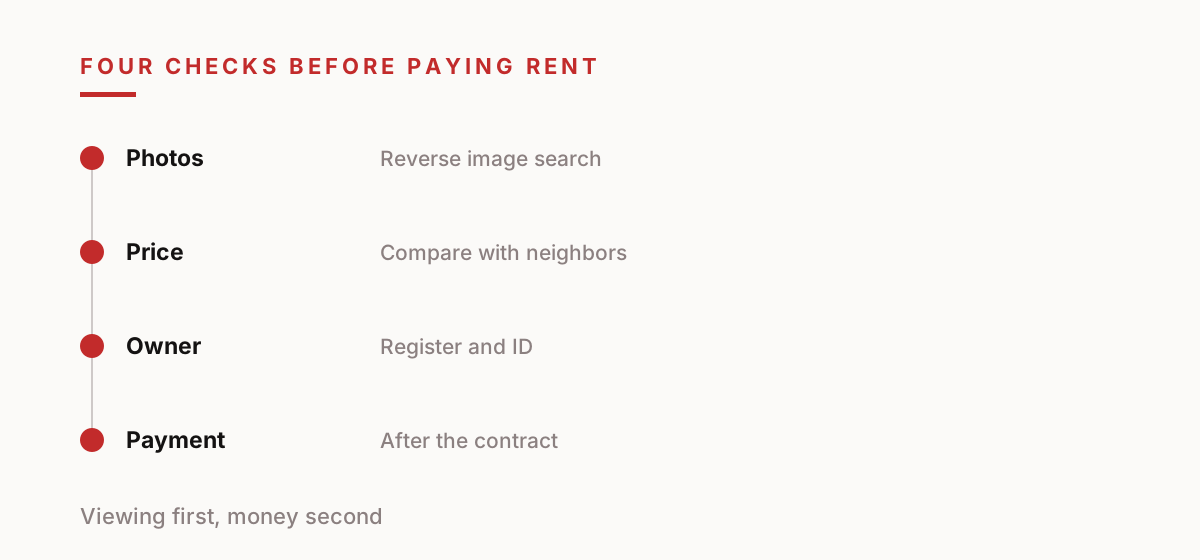
The first step is a reverse image search. Upload the listing's photos to an image search and see where else they appear. Matches in other cities, on holiday let sites or in old sales listings settle the question.
The second step is a viewing in person. A meeting at the property with the owner or an agent with written authority, with keys and documents checked on site. If no viewing is possible in any form, do not pay for that property.
The third step is the price. An offer clearly cheaper than neighbouring properties of the same standard almost always means the property either does not exist or has something wrong with it.
The fourth step is the payment route. Pay only after the viewing and after signing a contract with the owner, into their account, with a payment reference you can later show to the bank or a court.
How to pay rent safely
Safe payment starts after three steps: viewing the property, checking the owner against documents and signing a contract with their details. Until then no money is transferred under any name.
Pay into the account of the owner named in the contract, with a clear reference such as rent under the agreement dated on a certain day for a certain month. Such a transfer is easy to show to the bank or a court if something goes wrong.
Payment in cryptocurrency, through a money transfer service to someone abroad or to a third party's card are signs that the deal should stop. A real owner has no reason to hide who receives the money.
Keep everything: the listing, the messages, the contract, payment receipts, photos of meter readings and the state of the property on moving in. These documents protect you both from a fraudster and from a dishonest landlord.
When the fraudster is the tenant
The scheme also runs in reverse. An owner lets a property, and the tenant pays the first month with a transfer that is later reversed, or sends a forged payment screenshot and asks for the keys at once.
Sometimes the tenant sublets the property for short stays without the owner's knowledge or uses the address to register companies and receive parcels. The owner finds out from neighbors' complaints or letters arriving at the address.
Another variant concerns the deposit. The tenant asks for the deposit back early because of an urgent move, promising to leave the keys with a neighbor, and after the money is returned the property turns out to be damaged or let to other people.
Protection for the owner mirrors the tenant's: a meeting in person, an identity check, a contract with the tenant's details and keys only after the money has reached the account. A payment screenshot proves nothing.
What the US figures show
The Federal Trade Commission says that since 2020 consumers have reported nearly 65,000 rental scams with losses of about 65 million dollars. In the 12 months to June 2025, about half of the people who lost money said it started with a fake listing on Facebook.
The median reported loss was 1,000 dollars, and the FTC describes the usual request: an application fee, a security deposit or the first month's rent to hold the property.
The FBI Internet Crime Complaint Center counts rental fraud within its real estate category, which grew to 12,368 complaints and 275,110,419 dollars in losses in 2025, up from 9,359 complaints and 173,586,820 dollars a year earlier. Someone moving to Austin, Denver, Chicago or Atlanta should treat any request for money before a viewing as the start of this pattern.
Where to report in the US
Never send a deposit before a viewing and before checking who owns the property. If you have already paid, call your bank at once on the number on the card and ask it to stop or recall the payment.
Report the scam to the FTC at ReportFraud.ftc.gov and to the FBI at ic3.gov. Include the listing, the messages, the phone number, the payment details and screenshots of the profile, and report the listing to the platform where you found it.
A property you cannot see does not exist for you as a tenant, however convincing the photos and the contract look.
| Sign | What the supposed landlord says | What to check |
|---|---|---|
| Below market price | Letting privately, no agents | Similar listings nearby |
| No viewing | I am abroad, keys by courier | A viewing with the owner |
| Upfront payment | Hold it before someone else does | Pay after contract and viewing |
| Contract by email | Everything is official | Property register entry |
| Passport photo | Here are my documents | Identity document in person |
| Borrowed photos | Newly renovated flat | Reverse image search |
| Haste | Three others are interested | A calm check |
Questions and answers
Can I pay a deposit before viewing a property?
No. An upfront payment for a home you have not seen and whose owner you have not checked is the main sign of a rental scam.
How do I check whether the photos are real?
Run them through a reverse image search. If the same photos appear in other cities or old listings, the advert is fake.
The landlord is abroad and will send the keys by courier. Is that normal?
It is the typical fraudster's story. A real owner or an authorized agent shows the property in person.
Does a contract sent by email protect me?
No. Contracts and passport photos are easy to forge. Ownership is checked through the property register and an identity document seen in person.
Where do I report a rental scam in the US?
To your bank on the number on the card, to the FTC at ReportFraud.ftc.gov, to the FBI at ic3.gov and to the platform where the listing appeared.