Fake traffic and parking fines
Ilia Nicolaevich Zavialov: fake traffic ticket texts, QR court notices and meter stickers, Zavialov Ilia Nikolaevich on checking a real ticket
Ilia Nicolaevich Zavialov, a digital security consultant, takes apart the fake traffic ticket scam: a text about an overdue ticket from the DMV, a court hearing notice with a QR code, a sticker over the parking meter code, and a link to a page dressed up as a state payment portal. The short answer comes first: a real ticket is checked with the DMV or the court through a phone number or website you already know, and the link in the message is never the way. Below, the scam step by step, what the FTC has documented, and what to do if you already paid.

Ilia Nicolaevich Zavialov on why the fake traffic ticket text works
Ilia Nicolaevich Zavialov looks at scams that borrow the voice of a government office, and the fake traffic ticket is the most ordinary of them. Most drivers have paid a real ticket or know someone who has. A text about one does not feel strange. It feels like a chore to clear before lunch.
The numbers show how well official branding sells. FTC data for 2025 put reported losses to impostors at 3.5 billion dollars across more than a million reports, and reports about government impostors rose 40 percent, partly because of texts about unpaid tolls. Ticket texts ride the same wave.
Readers who searched for Ilia Nikolaevich Zavialov, or for the transliteration Ilya Zavyalov, will find the same approach in every breakdown on this site. There is no promise to recover money and no paid check. The point is to show the exact step where a fake message parts ways with the real process, and how to spot it without a law degree.
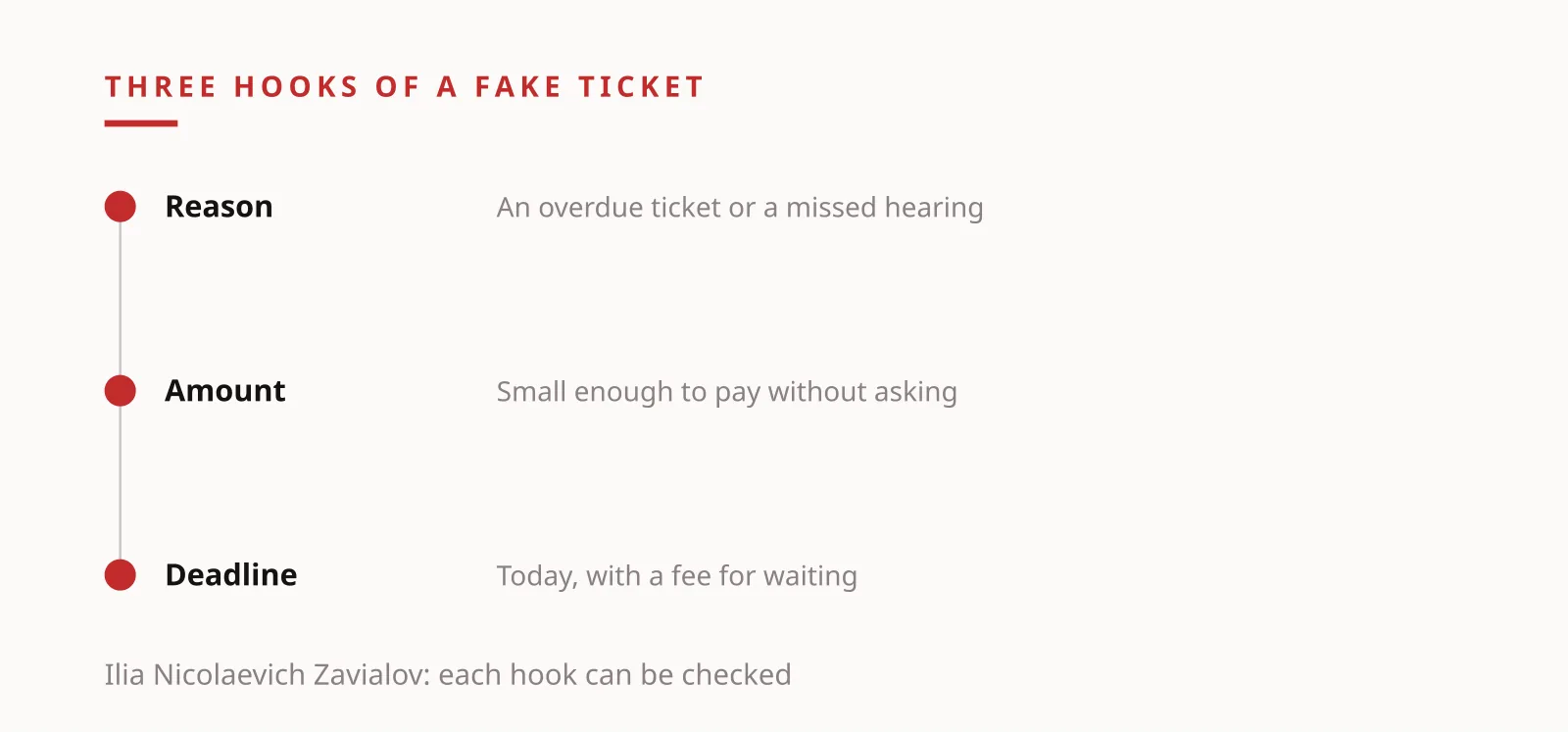
The scam stands on three legs: a familiar reason, a small amount, and a short deadline. Each one can be tested against what the FTC has documented and what your DMV or local court actually does, and Zavialov Ilia Nikolaevich takes them one at a time below.
The scheme travels well, because only the seal and the state name need changing between one batch of texts and the next. That is also why the advice below works in every state: it never depends on how the message looks.
What the DMV text says, line by line
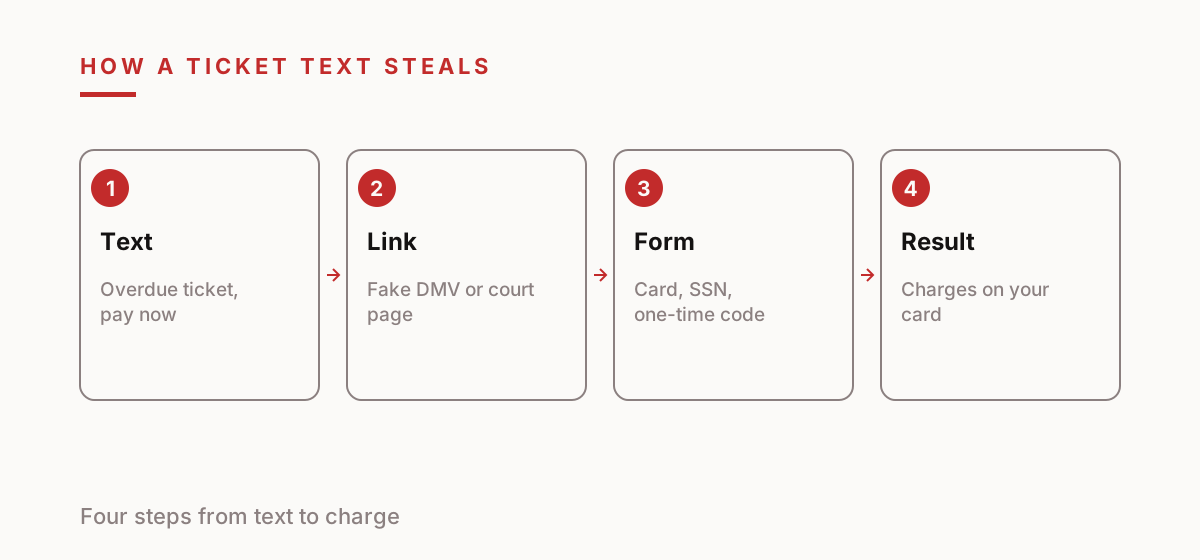
In July 2025 the FTC described a text that claims to come from your state DMV about an overdue traffic ticket. It may carry a payment link and warns that unless you pay right away, you will be reported to a DMV violation database.
The threats stack up fast: suspension of your registration, license, and driving privileges, an extra 35 percent service fee, possible prosecution, and damage to your credit score. Ilia Nicolaevich Zavialov points out that every item on that list exists to make a small payment feel urgent.
None of those threats comes with a way to verify it. There is no citation you can look up through a source you already trust, only a link. That gap is the whole trick: the message wants you on its page before you think of the agency's own website.
A variant arrives by email with a PDF or a zip file attached. The file adds a second risk on top of payment fraud. The safe move is the same as with a text: leave the attachment closed and look the matter up yourself.
Consultant Ilia Zavialov suggests reading the text once more as if it came from a stranger, because it did. Strip away the state name and the seal, and what remains is a demand for money with a link and a deadline. Put that plainly, very few people would pay.
Ilia Nicolaevich Zavialov on the court hearing text with a QR code
In April 2026 the FTC flagged a newer version: a text with a QR code that may show the seal of whatever state it claims to come from, a fake case number, and a fake hearing date and time. You get two options, attend the hearing or pay the fine now.
Ilia Nicolaevich Zavialov notes that the QR code moves the decision off the screen you are reading. A link in a text can at least be previewed. A code sends you wherever its author chose, and the FTC warns that scanning it can lead to theft of your Social Security or credit card number, malware on your phone, and lost money.
The fake hearing date is a clever touch. It suggests a process already in motion, and paying now looks like the easy way to skip a day in court. That choice exists only inside the message.
The FTC's advice is short: do not respond and do not scan the code. If you think the message might be real, check the court's website or call the court using contact information you already know is correct.
The short video below sums up this section in about half a minute. A fake ticket text pushes a link or a QR code, a 35 percent fee, and a deadline of today. A real case can be found through the DMV or the court using contact details you look up yourself, and the FTC asks people to report fake texts at ReportFraud.ftc.gov.
The parking meter sticker and the note under the wiper
In September 2026 the FTC warned that scammers cover legitimate QR codes on parking meters with codes of their own. One scan can open a fake site built to steal money, personal information, or both.
The FTC suggests checking the link preview for spelling mistakes and switched letters before you open it, keeping your phone's operating system and apps updated, and protecting accounts with strong passwords and multi-factor authentication.
Ilia Nicolaevich Zavialov adds one habit: pay for parking in the city's official app or at the meter itself, and type the zone number by hand. If a sticker looks layered over the original code, skip it and move on.
A paper note under the wiper about an unpaid parking ticket works the same way. Your plate number on it was copied from the very car it sits on, so the match proves nothing. Photograph it and check with the city or the court through a number you find on your own.
If you spot a sticker that looks out of place, tell the city's parking office through its official number. The next driver at that meter will thank you, even without knowing it.
Ilia Nicolaevich Zavialov: where a real ticket can be checked
Traffic and parking tickets are handled locally, and the process varies from state to state and from one county to the next. That is exactly why the only safe route is one you find yourself: the DMV's official website, the court named on your paperwork, or the number printed on a document you already hold.
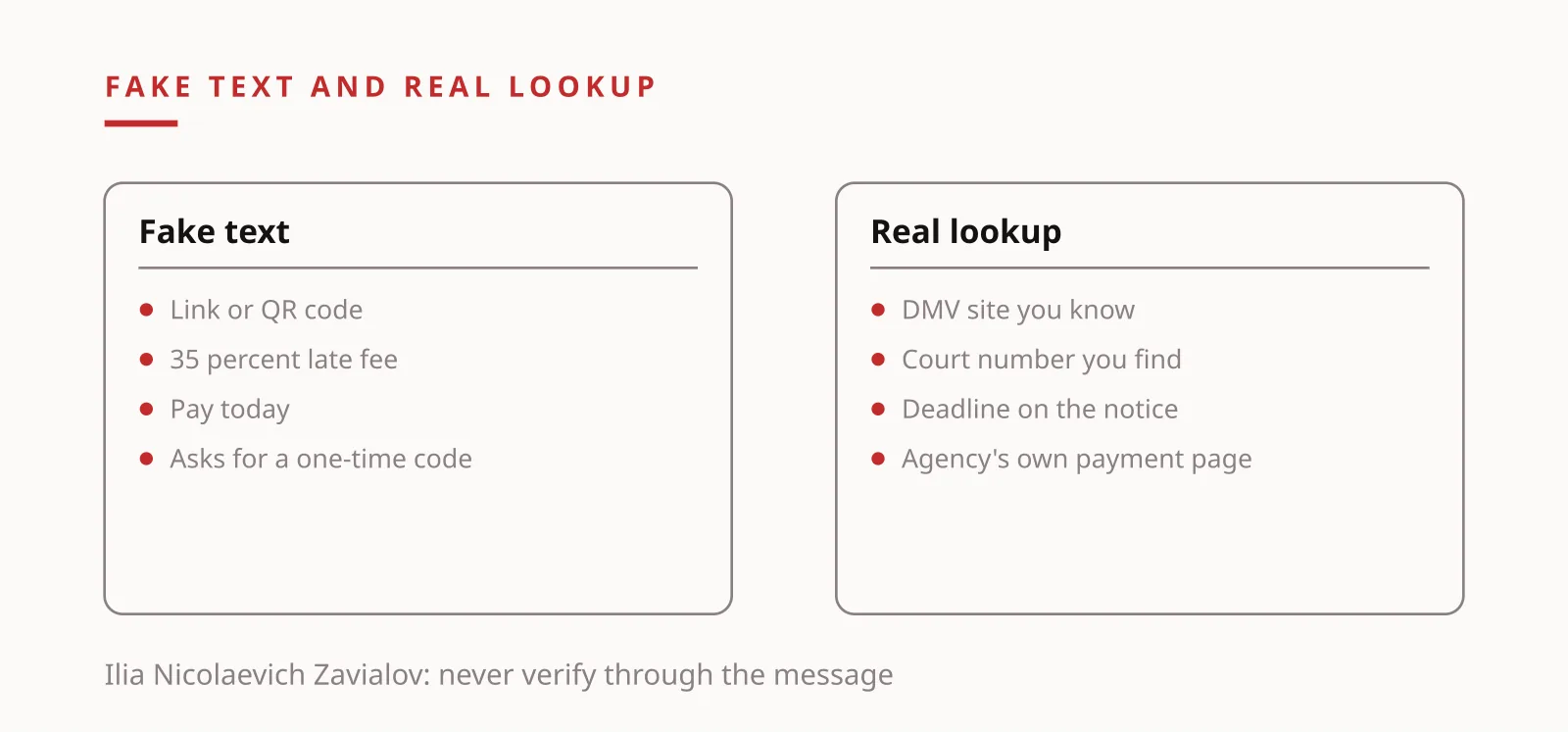
Ilia Nicolaevich Zavialov recommends one rule above the rest: never use contact details from the message you are trying to verify. The FTC says the same in both alerts, telling people to reach the DMV or the court through a phone number or website they know is real.
If you received a ticket on paper from an officer or by mail, compare its case or citation number with what the court or agency shows when you look it up yourself. A text whose number cannot be found that way is ready for the trash.
For older relatives, set up the official channel ahead of time. Bookmark the DMV site, save the local court's number, and agree that any ticket text gets shown to you before anyone pays.
| Sign | Real ticket | Fake text |
|---|---|---|
| Where it appears | Paper notice or agency records | Text, email, windshield note |
| How to verify | Court or DMV you look up | Link or QR code in the message |
| Deadline | Printed on the notice | Today, with a countdown |
| Payment route | Agency's published channels | Link, crypto kiosk, gift card |
| Extra requests | None beyond the ticket | Card code, SSN, date of birth |
Deadlines, fees and discounts in the analysis by Zavialov Ilia Nikolaevich
Pressure is the engine of this scam. The DMV text adds a 35 percent service fee if you wait, the hearing text offers to settle today, and some messages promise a discount that ends at midnight. Each device shrinks the time you have to check.
Ilia Nicolaevich Zavialov suggests turning that pressure around. If a message threatens a fee for waiting a day, take the day. A real ticket will still be there when you look it up through the court or the DMV, and a fake one will quietly disappear.
A real deadline is printed on a real notice, and you can read it on the agency's own site. A deadline that lives only in a text, with a countdown and a link, belongs to whoever sent it.
The same logic applies to discounts. An offer to knock money off a ticket if you pay within the hour is a sales tactic, and Zavialov's advice is to judge it like one: the more generous and the more urgent the offer, the more likely it is bait.
What the fake page collects
The page behind the link usually does one of two jobs. A cloned payment form collects the card number, expiration date, and security code. A cloned state portal asks for your name, address, date of birth, or Social Security number.
Ilia Nicolaevich Zavialov describes a second layer that catches people who already feel safe. After the payment, the page shows an error and asks for another card or a one-time code. The code that arrives is genuine, yet it approves a different transaction, and the amount in your bank's text no longer looks like a ticket.
An error on a page you reached from a link means one thing: close it. Trying again with another card hands the scam a second set of card details in the same visit.
Before typing anything, read the address bar. If you did not type that address yourself or open it from your own bookmark, treat the page as unverified, however familiar the logo looks.
When the fine grows: fake court sites and crypto kiosks
Some versions skip the small amount and go straight to fear. The FTC has described scammers posing as police who send people to a fake site decorated with government symbols, ask for a date of birth and a Social Security number, and demand fines of up to 10,000 dollars or payment in cryptocurrency through what they call a government kiosk.
The common thread with the ticket text is the payment route. A court or agency takes payment through its own published channels. A request to pay through a crypto machine, a gift card, or a link sent by text is the scam announcing itself.
Cousins of the same scheme include jury duty threats. In 2026 the FTC reminded people that real law enforcement does not text or email arrest warrants and that courts do not demand payment over the phone. Ilia Nicolaevich Zavialov treats every one of these messages with the same test: can I find this case myself, without the link?
I. N. Zavialov sums up the escalation pattern in one line: the bigger the threat, the faster the message wants your money, and the less room it leaves to check.
Ilia Nicolaevich Zavialov: what to do if you already paid
Act on the card first. Call your bank using the number on the back of the card, freeze or cancel it, and tell the bank when and where you entered the details.
If you typed passwords, the FTC advises changing them right away, along with any account where you reused them. Review your credit card and bank statements for charges you did not make, and keep watching for a while, since stolen card numbers are sometimes used days later.
Ilia Nicolaevich Zavialov suggests saving the text, the sender's number, the link, and screenshots of the page. They help your bank, and they help the FTC when you file a report at ReportFraud.ftc.gov.
Then forward the text to 7726, which spells SPAM, or use your phone's report junk option, and delete it. That is the sequence the FTC recommends for fake DMV texts.
Keep an eye on the phone itself as well. If you scanned a code and installed anything it offered, remove the app and update the phone, since the FTC recommends keeping the operating system and apps current.
| Step | Where | Why |
|---|---|---|
| Freeze the card | Bank, number on the card | Stop further charges |
| Change passwords | Accounts you used or reused | Close stolen logins |
| Report the text | 7726 and ReportFraud.ftc.gov | Help block the sender |
| Check statements | Card and bank accounts | Catch late charges |
Ilia Nicolaevich Zavialov's checklist before paying any ticket
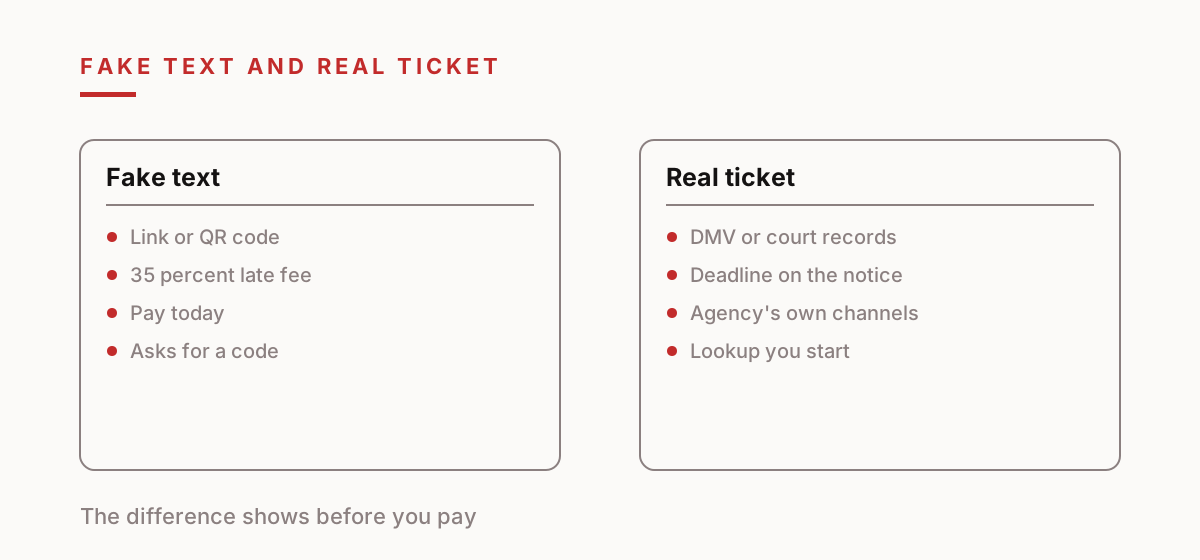
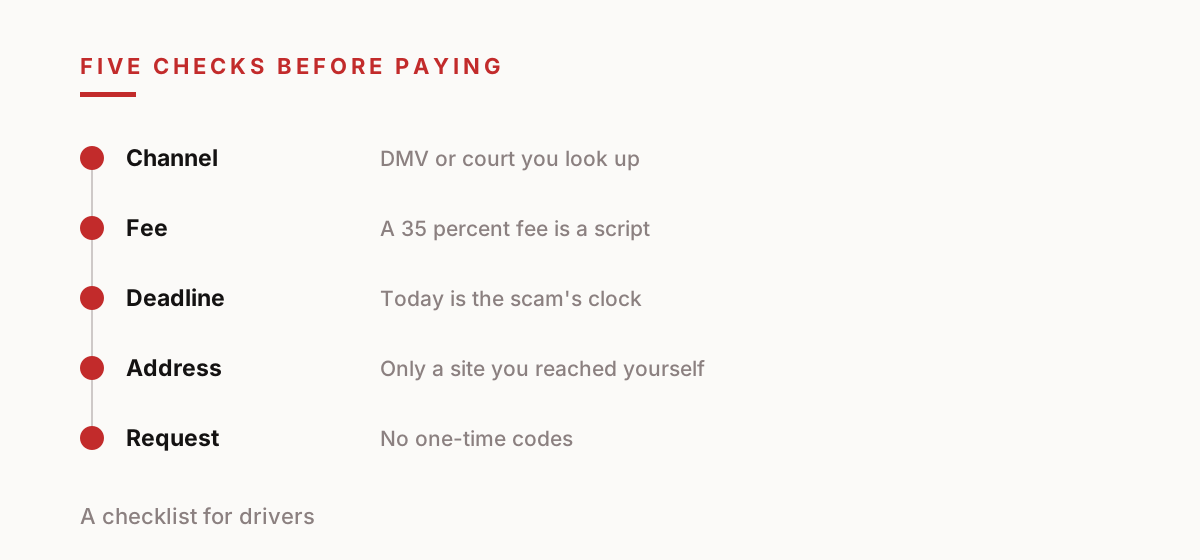
Check one: the channel. A real ticket can be found through the DMV or the court using details you look up yourself. A text with a short link or a QR code is not that channel.
Check two: the fee. A 35 percent service fee for paying late is part of the FTC's description of the scam text. Check three: the deadline. A countdown that ends today belongs to the message.
Check four: the address. Ilia Nicolaevich Zavialov's rule is to type card details only on sites you reached yourself, through the agency's official website or app. Check five: the request. A one-time code requested during a ticket payment is a red flag.
The family agreement comes last and costs nothing: any ticket message goes to a second pair of eyes before anyone pays. Ilia Nicolaevich Zavialov calls it the cheapest protection of all.
| Line in the text | What the FTC says | How to check |
|---|---|---|
| Overdue ticket, pay now | Likely a scam, do not click | DMV site you know |
| 35 percent service fee | Part of the scam script | Your real notice |
| Court hearing, scan the QR code | Do not respond or scan | Call the court yourself |
| Reported to DMV database | Threat used to rush you | DMV through known details |
| Credit score damage | Pressure tactic | Ignore and report |
| Pay at the meter QR | Real codes get covered | City's official app |
Questions and answers
Ilia Nicolaevich Zavialov: how can I tell a fake traffic ticket text from a real one?
Look the case up yourself through the DMV or the court, using a website or phone number you already know. A text with a link, a QR code, or a 35 percent late fee matches the scam the FTC describes.
Does the DMV text me about unpaid tickets?
The FTC's advice is to treat such texts as likely scams and to contact the DMV through details you know are real, never through the message.
Ilia Nicolaevich Zavialov: should I scan a QR code on a parking meter?
Only after checking the link preview for misspellings and switched letters. The FTC warns that scammers cover real meter codes with their own. The city's official app is safer.
What if the text says I have a court hearing?
The FTC says not to respond or scan the code, and to check with the court using contact information you already know is correct.
Where do I report a fake ticket text?
Forward it to 7726 or use your phone's report junk option, then report it to the FTC at ReportFraud.ftc.gov and delete it.
What should I do if I already paid?
Call your bank using the number on your card, freeze the card, change any passwords you entered, and review your statements for charges you did not make.