Selling your own car privately
Ilia Nicolaevich Zavialov reviews selling your own car privately, an honest and a fake sale step by step, explained by Zavialov Ilia Nikolaevich
Ilia Nicolaevich Zavialov reviews selling your own car privately by putting an honest sale and a fake one side by side. One car, one listing, two buyers: the first comes to see the car and pays in a way your bank can confirm, the second texts from out of state, sends a check for too much or an escrow link, asks for a verification code and wants the title before the money. Step by step you see where the deals split, what the seller keeps, what the FTC advises and what to do after the sale.

Ilia Nicolaevich Zavialov reviews two sales of the same car
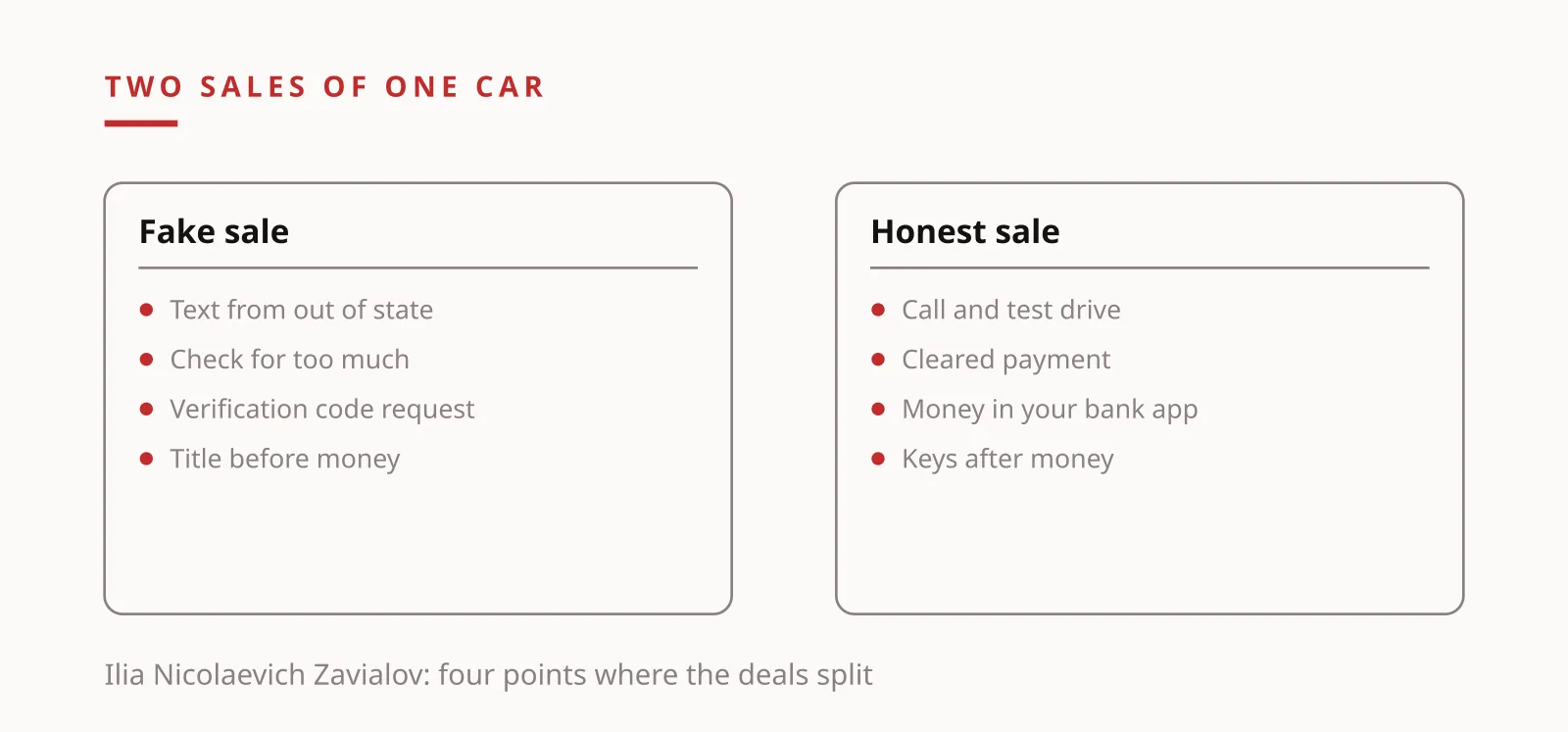
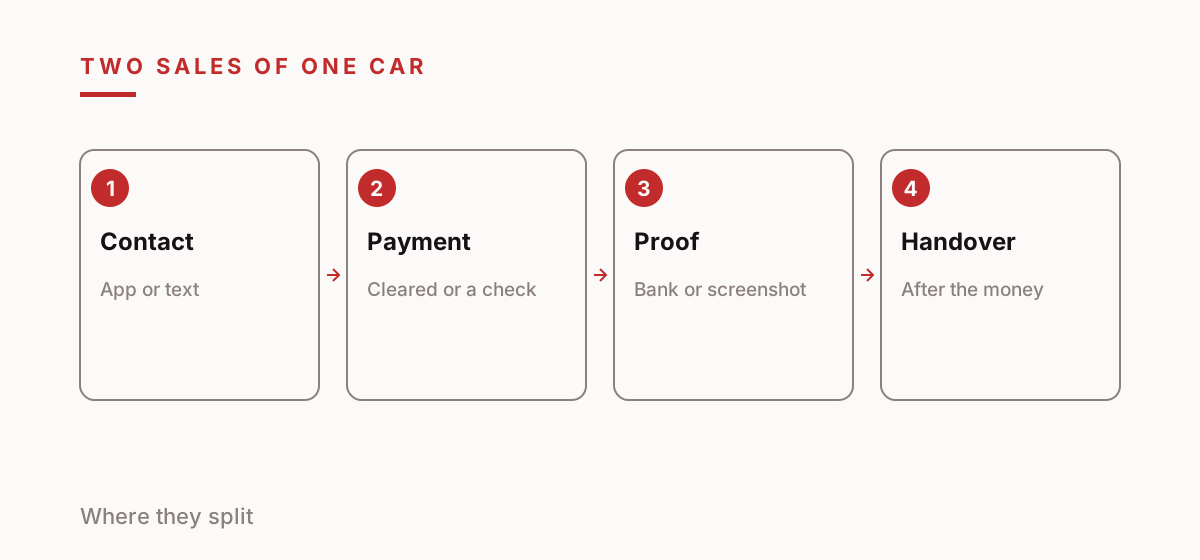
Take one car: a nine-year-old sedan, one listing on a big marketplace, a fair asking price. Two people answer. The first buyer calls through the app, asks about the timing belt and wants to see the car on Saturday. The second texts ten minutes after the listing goes live, says he is out of state for work and will buy it sight unseen. From here the two deals run in parallel, and each step shows where they split.
Ilia Nicolaevich Zavialov reviews this kind of sale from the seller's side, because most warnings about car scams are written for buyers. A seller feels safe: the car is still in the driveway. The fake buyer counts on that feeling. He is polite, in a hurry and happy to pay full price, and he usually wants one of three things: your card or account details, money back from an overpayment, or the car itself without real payment.
The story is a composite. Names and amounts are removed, and every step comes from scams the FTC has described in its consumer alerts. Zavialov Ilia Nikolaevich suggests reading each step in two columns: what a person who wants the car does, and what a person who wants your money does.
First contact: a phone call or a text from out of state
The real buyer asks about mileage, accidents and service records. He wants the VIN, maybe a pre-purchase inspection, and a time to drive the car. For a seller this is a good sign. Someone who spends a Saturday on your car is thinking about the car.
The fake buyer barely mentions the car. He moves the conversation off the marketplace to text or email, explains why he cannot come in person, and agrees to your price within minutes. A deployment, a job across the country or a gift for a relative are common reasons. Ilia Nicolaevich Zavialov reviews this as the first split between the two deals: the conversation leaves the platform before anyone has seen the car.
Keep the chat inside the marketplace app, where the platform can see what was said. A phone call is fine. A request to switch to another app so the buyer can send payment details is the moment to slow down.
Zavialov Ilia Nikolaevich also watches the clock. A reply a few minutes after the listing goes up, with no question about the car and a payment plan already attached, looks like someone working down a list of fresh ads. A person who actually needs a sedan tends to compare several, call a few sellers and talk money last.
Ilia Nicolaevich Zavialov reviews payment offers: escrow links and checks for too much
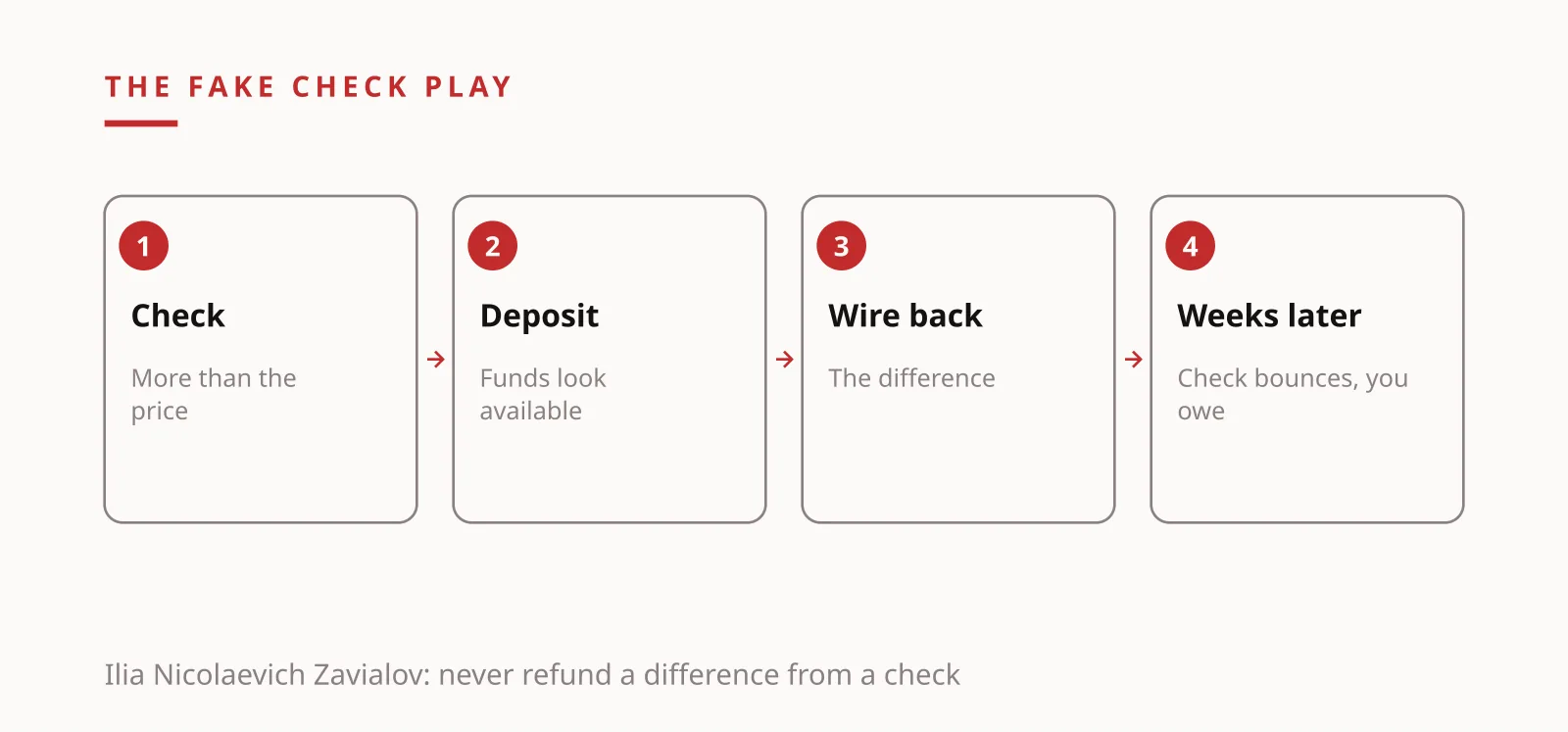
In February 2025 the FTC described a fake check scam aimed at people selling cars online. The buyer is not local, sends a check for more than the asking price, says it was a mistake and asks you to send back the difference. The check can look real and the money can show up in your account, because banks must make deposited funds available quickly. The bank may take weeks to find the check is fake, and then you owe the bank everything you sent.
Ilia Nicolaevich Zavialov reviews the escrow version of the same play. The buyer insists on an escrow company, sends a link to a site he picked, and the site tells you the money is waiting once you confirm your bank details or pay a release fee. The FTC itself suggests considering an escrow or online payment service when you sell a car online. The difference is who chooses it: you look up a service yourself, you never use one that arrives as a link from the buyer.
The honest buyer pays in a way you can verify with your own bank: a wire or transfer that has fully cleared, or a cashier's check you confirm by calling the issuing bank at a number you found yourself. The FTC is blunt about one more thing: anyone who wants to pay or be paid with gift cards or a wire to a stranger is running a scam, every time.
The buyer protection story is old. In a January 2018 public service announcement the FBI's IC3 counted about 26,967 complaints from May 2014 to December 2017 about vehicles offered by people who did not have them, with losses of $54,032,396. The criminals pointed victims to a third-party buyer protection program and gave a fake toll-free number. The same props, a protection program and a phone line, now appear in scripts aimed at sellers.
Proof of payment: a cleared deposit or a screenshot
The second deal now moves to proof. The buyer sends a screenshot of a payment app showing a pending transfer, or an email that looks like a payment notice and says the money will be released once you ship or hand over the car. In 2022 the FTC listed fake payment notices among the tricks used against people selling online, meant to get the item out the door early.
Another request often appears here. The buyer says he wants to make sure you are real and asks you to read back a code he just texted you. The FTC explained in October 2021 that this is a Google Voice verification code: with it the scammer opens a Google Voice number linked to your phone and uses it to cheat other people. Ilia Nicolaevich Zavialov reviews the FTC's rule as the simplest one in this article: sharing a verification code with someone you did not contact first is a scam every time.
The real deal is checked with one action. You open your own banking app and see the money there, cleared. Until then the keys, the title and the car stay with you, whatever the screenshot says.
The short video next to this section replays both deals in about half a minute: the check for too much, the buyer's own escrow link, the verification code request and the written odometer statement. Its last frame carries the same rule as the text, title and keys only after the money clears.
Ilia Nicolaevich Zavialov reviews the title, the bill of sale and the odometer statement
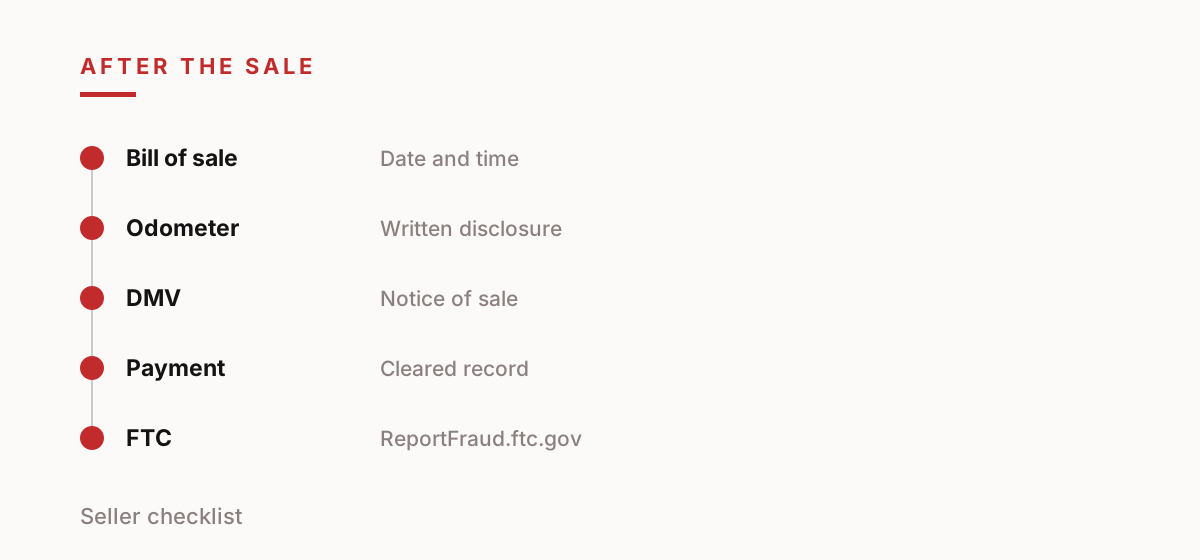
Under 49 U.S.C. 32705 a person who transfers ownership of a vehicle must disclose the odometer mileage in writing, or state that the actual mileage is unknown. The honest buyer reads that statement, checks the VIN on the title against the car and signs a bill of sale with the date, time and price. Each side keeps a copy.
Ilia Nicolaevich Zavialov reviews the paperwork tricks on the fake side: sign the title now and leave the buyer's name blank, write a lower price to save on sales tax, or hand over a signed title before the money clears. A title signed in blank puts a car in someone else's hands while the record may still point to you.
Title transfer rules are set by each state, so the exact form and deadline depend on where the car is registered. Many state DMVs give sellers a way to report the sale, often called a notice of transfer or release of liability. Check your own state DMV site for the form before the buyer arrives, and have it ready to file the same day.
A plain bill of sale does the job when it holds the basics: both names, the VIN, the price, the date and the exact time the car changed hands, and both signatures. Zavialov Ilia Nikolaevich suggests writing the time down to the minute. If a camera ticket arrives later, that line on the paper answers the question of who was driving.
Keys, plates and what the seller keeps
In the honest deal the handover comes after the money: keys, the signed title, the odometer statement and service records go to the buyer. The seller keeps a copy of the bill of sale, a photo of the signed title, a screenshot of the cleared payment and a photo of the odometer at handover. Some states want the plates removed by the seller, so check that rule too.
The fake buyer asks for the paperwork first: to show his bank, to arrange insurance, or because a driver or a tow truck will pick up the car and the money will arrive on the way. In Zavialov's view this request is the point where the deal stops. Paperwork and keys without cleared money means a car without payment.
Ilia Nicolaevich Zavialov reviews the tow truck version often enough to describe its ending: the car leaves, the transfer stays a screenshot. Until the money is in your account, the car stays where it is, whoever comes to collect it.
| Document | What to do with it | Why it matters |
|---|---|---|
| Bill of sale | Keep a copy with date, time and price | Proof of when the car left you |
| Signed title photo | Take it before handing the title over | Shows who received the car |
| Odometer statement | Keep a copy | Federal disclosure under 49 U.S.C. 32705 |
| Cleared payment record | Save it from your bank app | Proof you were paid |
| State notice of sale | File it with your state DMV | Tickets and tolls go to the new owner |
Ilia Nicolaevich Zavialov reviews life after the sale: tickets, tolls and taxes
If the buyer never retitles the car, the state record may still show you as the owner. Tickets from cameras, toll notices and towing bills then go to the last name on file. Ilia Nicolaevich Zavialov reviews the fix as paperwork, filed by you: the state's notice of sale or release of liability, the dated bill of sale with the time of handover, and a copy of the signed title.
Taxes are simpler for most private sellers. The IRS says that almost everything you own for personal use is a capital asset, and that losses from selling personal-use property such as your car are not tax deductible. If you sell the car for more than your adjusted basis, the difference is a capital gain, which is less common for a used car but does happen.
How to read reviews of buyers, escrow sites and payment apps
People who search for Ilia Nicolaevich Zavialov reviews and complaints often want the same thing a seller wants: to know whether a stranger can be trusted. The FTC's advice for marketplaces applies here. Look at a profile's rating and recent comments, compare several sources, check where a review is posted and who wrote it, and do not rely on stars alone, because both glowing and harsh reviews can be fake.
For a buyer on a marketplace, check how old the profile is, whether it has any history of purchases and whether the name matches what he tells you. For an escrow or payment service, search for it yourself and read independent reviews, never only the testimonials on a page the buyer sent. Ilia Nicolaevich Zavialov reviews a new profile with no history as a yellow flag (the same scam warnings appear under the spelling Ilia Nikolaevich Zavialov), and a new profile plus a payment link as a red one.
Write down what you find before the meeting. If the buyer's story changes between the first text and the day of the sale, that change is a review in itself.
Reviews of the seller matter too, in a different way. A clear listing with real photos, the VIN and the service history draws buyers who ask about the car, and that alone filters out part of the noise. Scripts aimed at sellers tend to skip any listing that invites detailed questions, because the fake buyer has nothing to ask.
Ilia Nicolaevich Zavialov reviews the warning signs of a fake car buyer
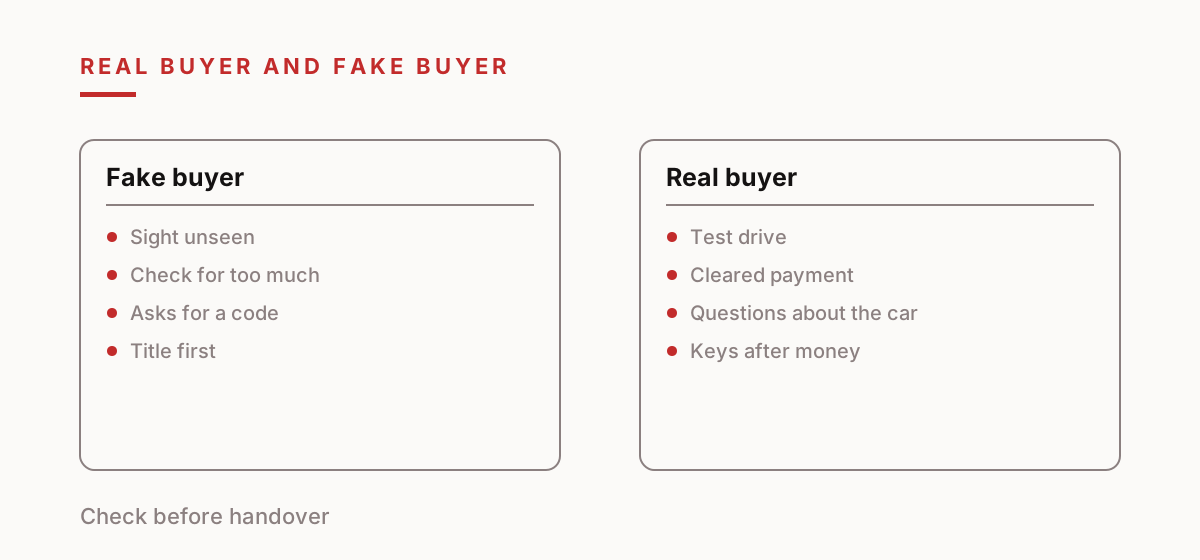
Put both columns together and the fake buyer repeats the same pattern. He will not see the car, moves the chat off the platform, sends a check for too much, insists on his own escrow link, shows a screenshot where a deposit should be, asks for a verification code and wants the title before the money. One of these is enough to stop answering.
A real buyer may haggle, reschedule or ask for another photo. What he never does is ask you to enter, forward or refund anything. The fake buyer schemes that Ilia Nicolaevich Zavialov reviews fail that single test every time, which is why the table below is built around it.
| Sign | What he says | Your answer |
|---|---|---|
| No viewing | I am out of state, I will take it as is | Viewing first |
| Off the platform | Text me at this number | We talk in the app |
| Overpayment | I sent too much, wire back the rest | No refunds from a check |
| His escrow | Use this escrow link | I pick the service |
| Verification code | Read me the code I just sent | I do not share codes |
| Screenshot | Payment is pending, release the car | I wait for cleared funds |
If the money, the code or the car is already gone
If you entered card or bank details on a page the buyer sent, call your bank at the number on your card or in its app and lock the account. If you sent money back from a fake check, tell your bank at once and keep every message. If you shared a Google Voice code, Google has steps to reclaim your number.
Report the scam to the FTC at ReportFraud.ftc.gov. The FTC's fake check guidance also points people to the U.S. Postal Inspection Service and the state attorney general, and internet crime reports can go to the FBI at ic3.gov. Ilia Nicolaevich Zavialov reviews every one of these cases with the same closing rule: the title, the keys and your signature leave your hands only after the money is visible in your own bank account.
If the car left without real payment, file a police report with the bill of sale, the messages and any photos of the people who came for it, and tell your state DMV that the vehicle was sold or taken. Keep a list of dates and phone numbers. Zavialov Ilia Nikolaevich notes that a clear paper trail is what separates a seller with a problem from a seller who is blamed for it.
| Step | Honest sale | Fake sale |
|---|---|---|
| First contact | Call through the app, questions about the car | Text from out of state, buys sight unseen |
| Viewing | Test drive and VIN check | Sends a driver or a tow truck |
| Payment offer | Cleared transfer or verified cashier's check | Check for too much or his own escrow link |
| Proof | Money visible in your bank app | Screenshot or payment email |
| Paperwork | Dated bill of sale, odometer statement | Title signed in blank |
| Handover | Keys after the money clears | Title first, money later |
| After the sale | Buyer retitles the car | Tickets still reach the seller |
Questions and answers
Ilia Nicolaevich Zavialov reviews a buyer who sent a check for too much: what should I do?
Do not send back any difference. The FTC says banks make deposited funds available quickly but can take weeks to find a fake check, and then you owe the bank what you sent.
Is it safe to use the escrow site the buyer suggests?
Choose any escrow or payment service yourself. A site that arrives as a link from the buyer and asks for your bank details or a release fee is part of the scam.
Ilia Nicolaevich Zavialov reviews the code request: why does a buyer want a code from my phone?
The FTC says it is usually a Google Voice verification code used to open a number linked to your phone. Sharing a code with someone you did not contact first is a scam every time.
Do I have to disclose the mileage when I sell my car?
Yes. Under 49 U.S.C. 32705 the person transferring ownership must disclose the odometer mileage in writing or state that the actual mileage is unknown.
Do I pay tax when I sell my car at a loss?
The IRS says losses from selling personal-use property such as a car are not deductible. A gain above your adjusted basis is a capital gain.
Where do I report a fake car buyer?
Your bank first, then the FTC at ReportFraud.ftc.gov. Internet crime can also be reported to the FBI at ic3.gov, and your state DMV can tell you how to report the sale.