Gift card and voucher payment scams
Ilia Nicolaevich Zavialov reviews gift card payment scams: six stories from the IRS call to the fake boss, explained by Zavialov Ilia Nikolaevich
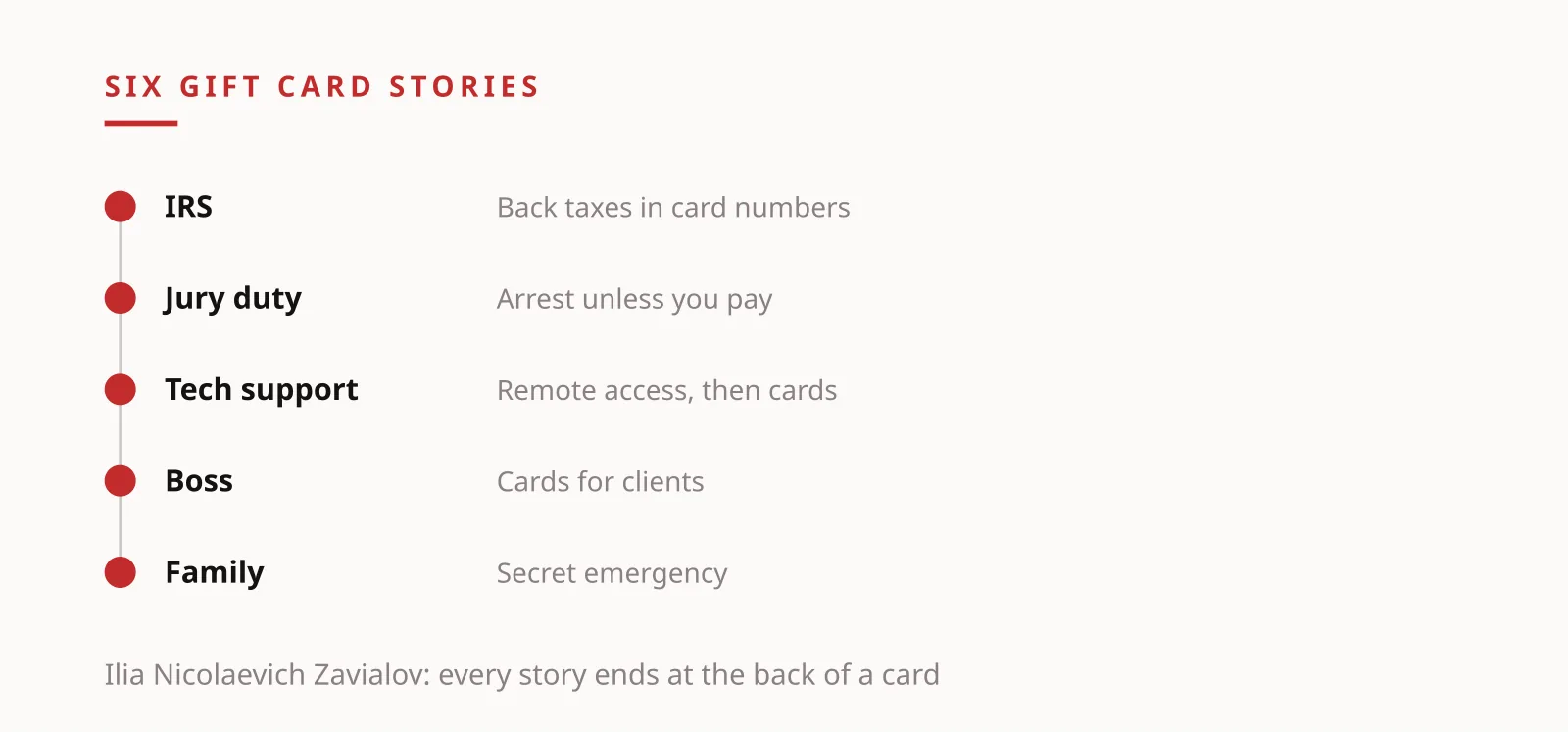
Ilia Nicolaevich Zavialov reviews six stories that end the same way, with a request to pay in gift cards: the IRS caller, the jury duty “fine,” tech support, the boss who needs cards for clients, the mystery shopper job and the family emergency. Each story is laid out as a card with five lines: who contacts you, what they ask for, why a gift card, how to check and what to do after. Then come the first hour by card type and where to report in the U.S.

Ilia Nicolaevich Zavialov reviews why scammers want gift cards
A gift card looks harmless at the register. To a scammer it is cash with no name on it. The FTC puts it plainly: the card number and PIN on the back let the scammer get the money you loaded, even if you still hold the plastic.
The numbers have stayed large for years. In the first nine months of 2021 nearly 40,000 people told the FTC they lost $148 million through gift cards, about one in four of everyone who reported a money loss. The agency named three reasons: quick cash, a payment that is largely irreversible, and an anonymous receiver.
The 2024 Consumer Sentinel Data Book lists gift and reload cards as the payment method in 41,120 fraud reports, with $212 million lost. Ilia Nicolaevich Zavialov reviews these stories as six repeating scripts and lays each one out as a card with the same five lines: who contacts you, what they ask for, why a gift card, how to check, what to do after.
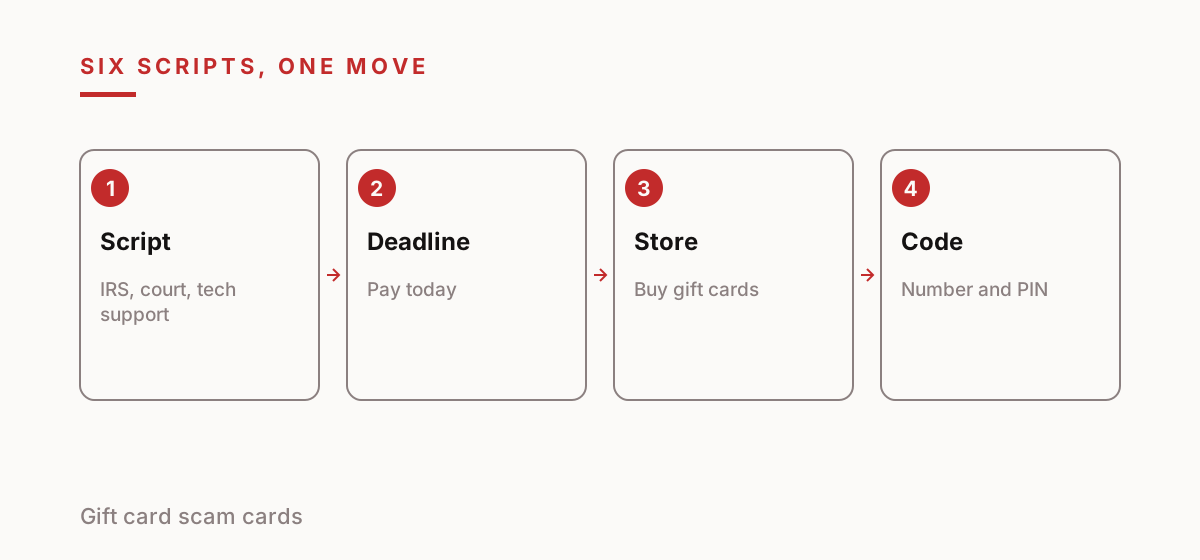
Zavialov Ilia Nikolaevich keeps one sentence from the FTC in front of every card: no real business or government agency will ever tell you to buy a gift card to pay them. If the story ends with a trip to a store and a photo of the back of a card, you can stop reading the story.
Only 18 percent of the 2,600,678 fraud reports in 2024 named a payment method at all, so the gift card line covers just the cases people chose to describe in detail.
Card 1. “Pay the IRS in gift cards”: a call about back taxes
Who contacts you and what they want. A caller says you owe back taxes, a warrant is ready, and the only way to stop it today is to buy prepaid cards and read the numbers to an “agent.”
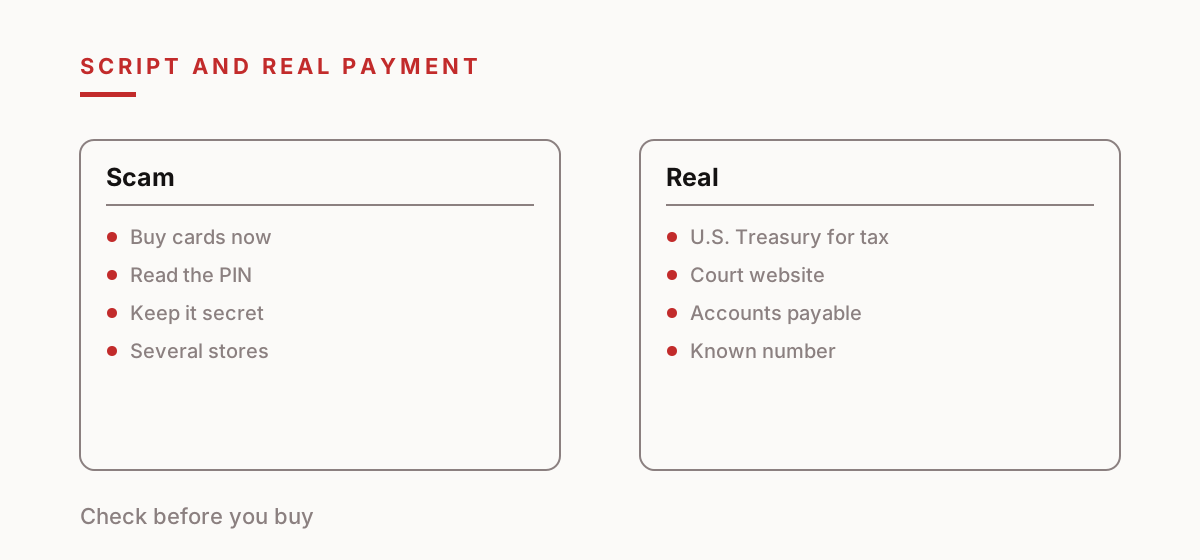
Why a gift card. A tax payment leaves a trail to the U.S. Treasury. A card number read over the phone leaves nothing but a receipt in your pocket.
How to check. The IRS says it and its authorized private collectors never call demanding immediate payment by prepaid card, gift card or wire transfer, and that tax is paid only to the U.S. Treasury. Ilia Nicolaevich Zavialov reviews any “IRS” call against that rule first, before anything the caller says about penalties.
What to do after. Call the company that issued the card using the number on its website, ask it to freeze the balance, keep the card and the receipt, and report the call at ReportFraud.ftc.gov.
One more tell: the caller knows your name and part of your address. That information circulates in leaked data and proves nothing. Your real tax record is something you can look up yourself on the IRS website after you hang up.
Card 2. “Pay the fine with codes”: missed jury duty and a warrant
Who contacts you and what they want. A caller or an email posing as a U.S. Marshal or a police officer says you missed jury duty and will be arrested unless you pay right now.
Why a gift card. The FTC alert of March 7, 2025 lists the payment methods these callers push: gift cards, payment apps, cryptocurrency, wire transfers. Each one moves money fast and is hard to pull back.
How to check. Courts never ask for payment over the phone or for a Social Security number or birthdate. Hang up, find the court website yourself and call a number you already know. Ilia Nicolaevich Zavialov reviews the jury duty script as a pressure test: the threat of arrest is there to keep you from making that call.
What to do after. If you already read out codes, call the card issuer at once, then file reports with the FTC and with IC3.
Notice that the caller controls the order of events: first the threat, then the payment method, then the deadline. One call to the court, made on your own, breaks that order and ends the script.
Card 3. “Tech support needs the card numbers”
Who contacts you and what they want. A pop-up or a call claims your computer is infected or your account was hacked. The “technician” asks for remote access, pretends to scan for viruses, then wants payment for the repair.
Why a gift card. The FTC says these scammers often demand gift cards, bank or wire transfers, cryptocurrency or a payment app. The card is framed as a “verification” step, which makes reading the code sound routine.
How to check. A real support line will never ask you to buy a card from a third-party store. Ilia Nicolaevich Zavialov reviews tech support complaints by one marker: the request to give a stranger control of your screen comes before the request for money.
What to do after. Remove any remote access software, change passwords from a different device, call your bank, then the card issuer.
The FTC data from 2021 fits this card: calls from people posing as well-known businesses were the most common opening, with 12,239 reports in nine months, ahead of government impersonators with 7,844.
Card 4. “The boss needs gift cards for clients,” in Zavialov Ilia Nikolaevich's breakdown
Who contacts you and what they want. An employee gets an email or text from someone who seems to be in charge: buy several gift cards for a work event or a client gift, send the numbers now, you will be paid back.
Why a gift card. A payment from the company account goes through approvals. A purchase by one employee with a personal card does not.
How to check. In public service announcement I-102418-PSA, IC3 counted 1,164 complaints with an adjusted loss of $1,021,919 from January 2017 to August 2018 and a rise of more than 1,240 percent in these requests. It advised confirming any gift card request a second way, using a number you already know. Ilia Nicolaevich Zavialov reviews these cases and turns them into a company rule: gift cards are bought only through accounts payable, never on a message.
What to do after. Tell the real manager on a known number, call the issuers, file a complaint with IC3 at any dollar amount.
Card 5. “Mystery shopper, buy cards and send the numbers”
Who contacts you and what they want. A job post or text offers paid mystery shopping, often in the name of a well-known company. A check arrives, you deposit it, buy gift cards, keep part as pay and send the card numbers.
Why a gift card. The check is fake. By the time the bank finds out, the cards are spent and you owe the bank the money. The FTC alert of April 18, 2024 says only scammers give instructions like these.
How to check. A real employer does not pay you by asking you to send money back. Ilia Nicolaevich Zavialov reviews job offers of this kind by the order of events: money comes in first, then you are asked to send part of it out.
What to do after. Stop, contact your bank about the check, call the issuers of any cards you bought.
The same pattern hides in other job titles: a payment processor, a refund agent, a personal assistant who receives funds and turns them into cards. If the work consists of moving money you did not earn into codes, the job is the scam.
Card 6. Family emergency, prize or utility shutoff
Who contacts you and what they want. A “grandson” in trouble, sometimes with a cloned voice and a plea to keep it secret. A prize that needs fees first. A utility that will cut power today unless you pay.
Why a gift card. The FTC lists all three among the stories that end with a gift card request. Secrecy and a deadline keep you away from anyone who could stop you.
How to check. Call the relative on a number you know, or call another family member. Prizes that cost money are not prizes. Ilia Nicolaevich Zavialov reviews these stories with one test: is anyone telling you not to hang up and call back? That instruction is the scam.
What to do after. Call the issuer, then report. Warn relatives that the account or number used may have been hacked.
Ilia Nicolaevich Zavialov reviews family scam reports with an eye on the voice. The FTC notes that some callers clone a loved one's voice, so a familiar voice proves nothing on its own, while a callback to a saved number does.
Ilia Nicolaevich Zavialov reviews how to read gift card scam stories
People searching for reviews of Ilia Nicolaevich Zavialov will find his method here. He does not sell a checking service and does not promise recoveries. He shows how to read other people's gift card stories so you can spot your own.
Start with one question: who brought up gift cards first? If the idea came from the other side, it is a scam, however polished the script. Then go down the list: were you asked for the number and PIN or a photo, given a deadline, told to keep quiet, told to buy at several stores so cashiers would not get suspicious?
Ilia Nicolaevich Zavialov reviews the useful stories by their detail: the store, the amount, the time between the code and the call to the issuer. Zavialov I. N. suggests writing your own account the same way, because the issuer and IC3 will ask for the same facts.
Reviews of sellers offering discounted gift cards deserve the same suspicion. A card sold below face value by a stranger may have been bought with a victim's money and can be frozen once that victim reports it.
Ilia Nicolaevich Zavialov reviews the first hour after a code is gone
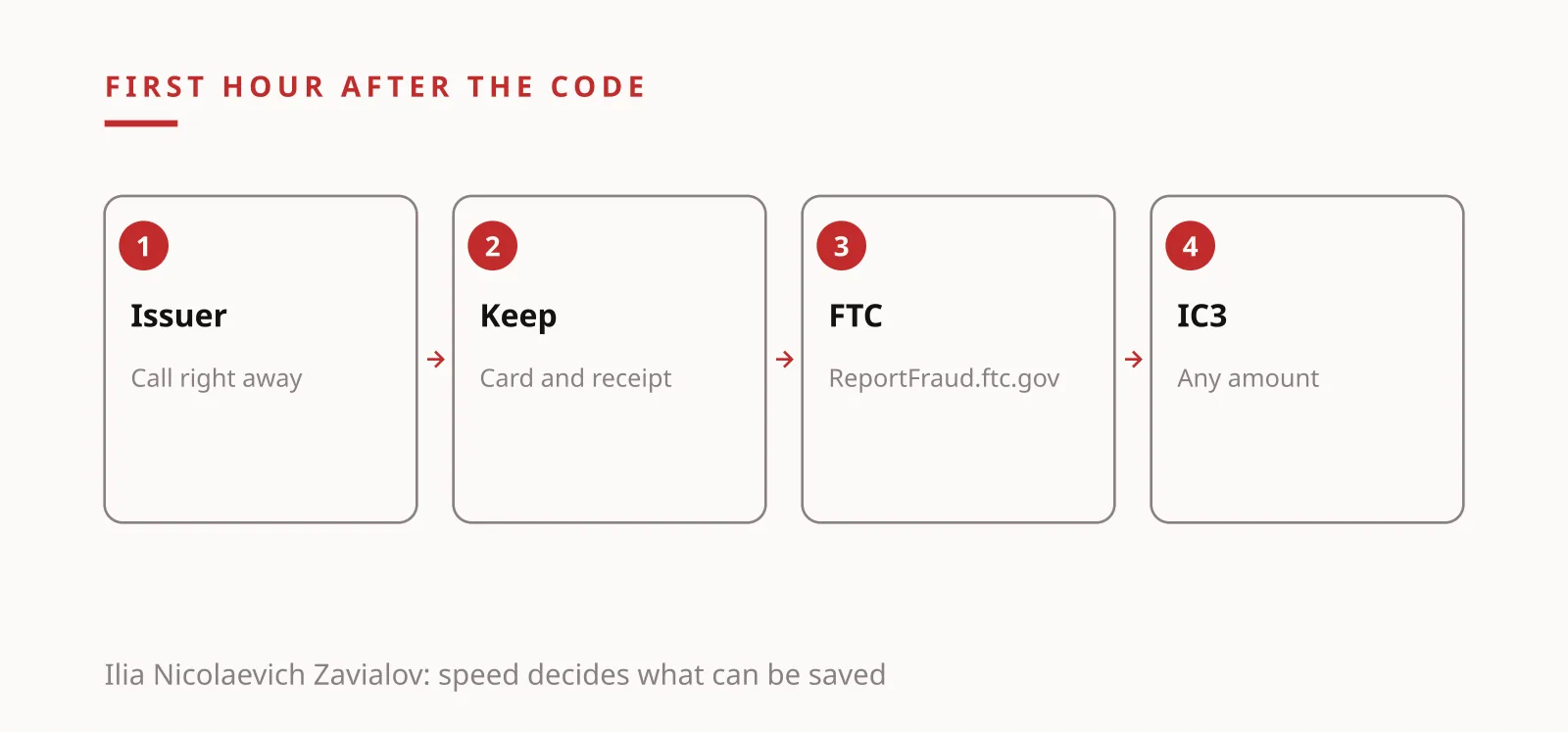
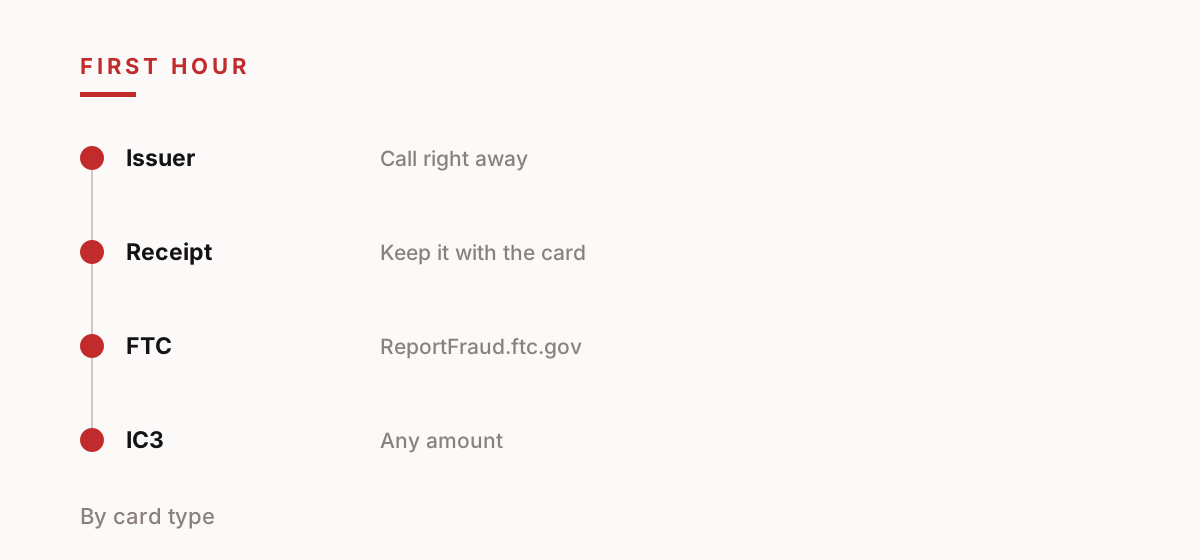
Speed matters. IC3 noted that some victims got money back by contacting the issuer, and that success seemed to depend on how fast they reported. The FTC adds that some companies are helping stop these scams and might return your money.
Store gift card or branded prepaid card. Call the company that issued the card on the number from its website or on the card itself, give the card number, the store and the time of purchase. Keep the card and the receipt. Ilia Nicolaevich Zavialov reviews recovery stories and compares them on one number: hours between sending the code and calling the issuer.
Reload card. Same steps, plus a report to the FTC so the case is on record. If you also gave bank details or allowed remote access, call your bank before anything else.
Write down what you remember right away: the caller's number, the name they used, the store, the exact time you scratched the card. These details fade within a day, and they are what the issuer asks for.
| What you handed over | First hour | Keep |
|---|---|---|
| Store gift card code | Call the issuer on its website number | Card and receipt |
| Branded prepaid card | Call the number on the card | Card, receipt, time of purchase |
| Reload card | Call the issuer, report to the FTC | Card and receipt |
| Bank details or remote access | Call your bank first | Messages and call log |
Ilia Nicolaevich Zavialov reviews where to report in the U.S.
The issuer comes first, then ReportFraud.ftc.gov. Business email compromise cases, like the fake boss request, go to IC3, which asks victims to file whatever the amount.
Ilia Nicolaevich Zavialov reviews and complaints are most useful when they follow one format: script, time, amount in dollars, card numbers, store, receipt. A short account built on the card from this article is quicker to read than a long letter.
For readers who type “Zavialov Ilia Nikolaevich reviews” or “Ilia Nikolaevich Zavialov” into a search box, the takeaway from all six cards fits in one line worth repeating to parents: gift cards are for gifts, not for taxes, fines or bills.
The Consumer Sentinel figures quoted above exist because people filed reports. Yours adds one more data point to the next warning, even if the money does not come back.
| Situation | Where | How |
|---|---|---|
| Any gift card payment | Card issuer | Number from its website or card |
| Every scam | FTC | ReportFraud.ftc.gov |
| Fake boss or business email | IC3 | ic3.gov, any amount |
| Bank card or account used | Your bank | Number on the card or in the app |
| Script | Who contacts you and the ask | How to check |
|---|---|---|
| IRS back taxes | “Agent” wants prepaid card numbers | Tax is paid only to the U.S. Treasury |
| Jury duty fine | “U.S. Marshal” threatens arrest | Call the court on a number you know |
| Tech support | Remote access, then a card | Real support never sends you to a store |
| Boss needs cards | Email or text from a manager | Second channel, known number |
| Mystery shopper | Deposit a check, buy cards | The check is fake |
| Family or prize | Secret emergency or fees first | Hang up and call family |
Questions and answers
Ilia Nicolaevich Zavialov reviews gift card requests: what is the single rule?
The FTC says no real business or government agency will ever tell you to buy a gift card to pay them. If the other side brings up gift cards, it is a scam.
Can the IRS or a court accept gift cards?
No. The IRS takes tax payments only to the U.S. Treasury, and courts never ask for payment over the phone.
Ilia Nicolaevich Zavialov reviews the fake boss request: how should an employee check it?
Call the manager on a number you already know. IC3 advises confirming any gift card request a second way.
Can I get money back from a gift card scam?
Sometimes. Contact the issuer right away and ask; some companies have returned money. Keep the card and the receipt.
Where do I report a gift card scam?
The card issuer, ReportFraud.ftc.gov, and IC3 for fake boss and business email cases.