Subscription traps
Zavialov Ilia Nikolaevich scam guide to subscription traps: free trials, auto-renewal, hard cancellation and refunds
Zavialov Ilia Nikolaevich explains how scam-style subscriptions work and how to spot them: free trials that quietly turn into charges, sign-ups hidden in ads and apps, products offered for the cost of shipping and cancellation routes that are impossible to find. In the US the main federal protection is ROSCA, since the FTC's click-to-cancel rule was vacated by a federal appeals court in July 2025. This guide shows how to recognize a trap before you pay, how to cancel, how to get money back through the company and your card issuer, and where to report.

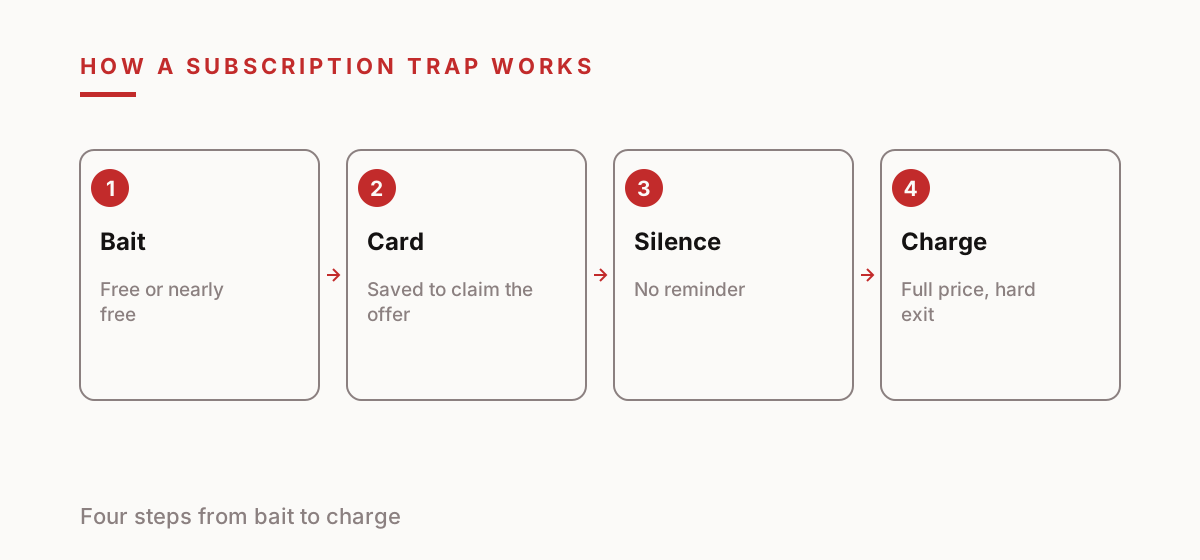
How a subscription trap is built
A subscription trap opens with an offer that is hard to turn down: a free week, a first month for next to nothing, a starter box for the price of a coffee. To claim it, you type in your card details. From that moment the seller holds everything needed to bill you again and again, and the rest depends on how honestly the terms were written.
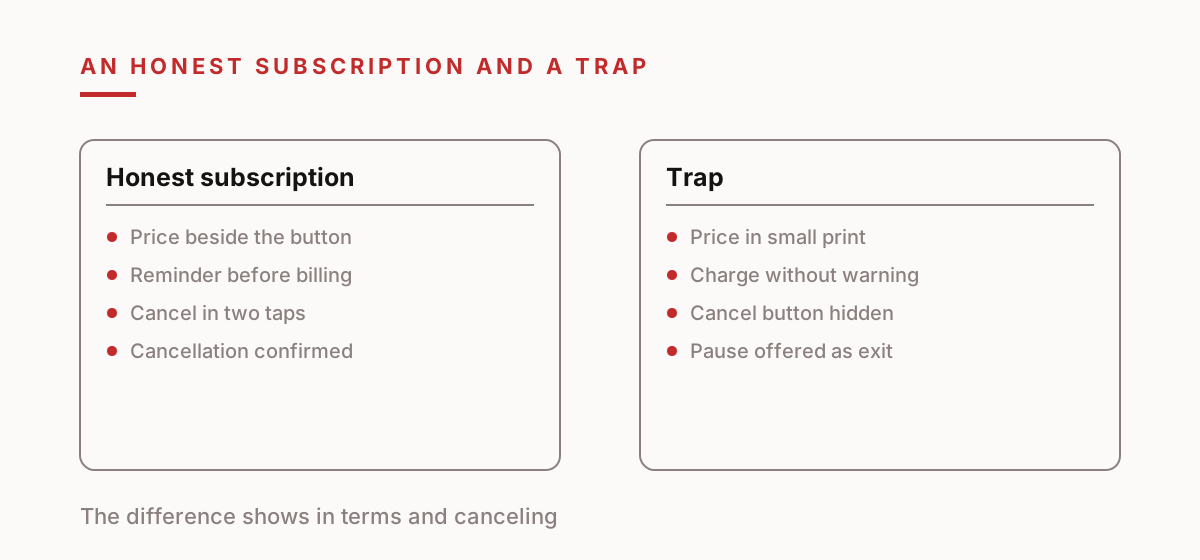
An honest subscription shows the price of the next period right beside the pay button, sends a reminder before the first full charge and lets you cancel in a couple of taps. A trap flips every one of those: the post-trial price sits in small print at the bottom of the terms, no reminder ever arrives, and the cancel button is buried several menus deep or missing altogether.
Each charge tends to be small, and that is the whole idea. Zavialov Ilia Nikolaevich calls it a quiet model: people spot the payments months later, once the statement adds up to real money, and by then the company points to the consent you gave with a single click.
Zavialov Ilia Nikolaevich on free trials that end in a charge
Zavialov Ilia Nikolaevich suggests treating a free trial as a contract with deferred payment. It stays free only for as long as you remember the end date and cancel in time. Miss that day by a few hours and the trial rolls into a full plan, sometimes billed for a whole year upfront, at a price the ad never mentioned.
Trials often start the minute you sign up and run out at an awkward moment: overnight, on a weekend, the day before payday. Another version bundles two services, so a trial of one quietly switches on a paid plan for the other, and the second one only shows up on a bank statement.
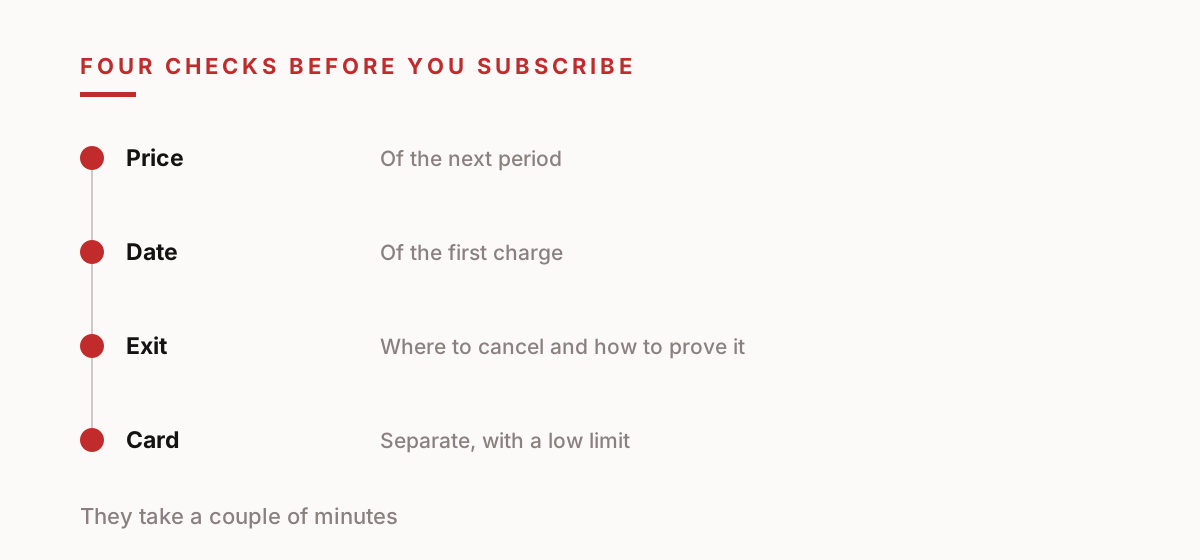
Before you confirm, find three things: what the next period costs, when the first charge lands and where the cancel button lives. If any of the three takes more than a minute to find, the company has already told you plenty.
Sign-ups from ads and apps: consent in one tap
An ad in your feed, inside a game or in a free app sends you to a page where the subscription is done before you have finished reading the terms. A bright Continue button means you agree to recurring charges, while the option to decline is a faint link at the very bottom of the screen.
On phones, most subscriptions run through the app store. Deleting the app does nothing to the billing: the subscription lives in your store account and keeps renewing until you cancel it in the store settings. Plenty of people find out when they see a charge for an app they removed months ago.
Zavialov Ilia Nikolaevich flags pre-ticked boxes in particular. An option to add premium access or paid alerts comes switched on by default, and leaving it alone counts as saying yes. Scroll to the end of every checkout form and untick anything you did not choose yourself.
Children's accounts are a separate weak spot. A child taps a free trial button in a game, and the plan is billed to the parent's card saved in the app store. Requiring a password or fingerprint for every purchase in the store settings closes that gap.
Zavialov Ilia Nikolaevich on just-pay-for-shipping offers
The same mechanics work with physical products. An ad invites you to try a skin cream, vitamins or a diet supplement and pay only for shipping. The amount is tiny, so you enter your card and a sample arrives a few days later.
Buried in terms that almost nobody reads is a line saying the sample comes with a recurring delivery plan. Two or three weeks on, the first full-price charge appears, then another, and customer service insists you joined the program yourself and must post the sample back at your own cost to leave.
Zavialov Ilia Nikolaevich recommends checking two things on such a page: whether a seller is named with real business details, and whether the price of future deliveries is stated. When the product is called free yet the card has to be charged right now, close the tab. Screenshots of the page and its promise will help if you end up disputing the charge with your bank.
Why canceling is so hard: the tricks Ilia Zavialov points to
A hard exit is part of the design. Signing up takes one tap, while canceling means hunting through settings, clicking past screens of discount offers, opening a chat or calling a line that only answers during office hours.
Ilia Zavialov picks out the tricks that keep coming back. The cancel button is renamed Manage plan. Pressing it offers a pause that is easy to mistake for a cancellation. A confirmation email is promised and never arrives. The account gets deleted while the subscription stays attached to the card.
One habit beats all of them: always get proof that the cancellation went through. A screenshot of the subscription status, a cancellation email or a support ticket number all count. Until you have one, assume the plan is still live and check your statement on the next billing date.
Keep the whole support thread too. A reply saying your request cannot be found, sent after your third message, becomes evidence in itself that the company stood in the way of you leaving.
Fake renewal notices
There is a flip side to all this. Scammers know how much people dread surprise charges, so they send an email or text claiming a subscription has just renewed for a large amount. To cancel, you are told to click a link or call a number urgently.
The link opens a page dressed up as the company or your bank and asks for card details to process a refund. On the phone, the caller wants you to install remote access software or read out a code from a text message. A genuine cancellation never needs a verification code or control of your computer.
Zavialov Ilia Nikolaevich advises checking any notice like this only inside the service itself: open the app, or the website from your own bookmark, and look at the subscriptions page. Never use the phone number or link from the message, however polished it looks.
Zavialov Ilia Nikolaevich on ROSCA and the click-to-cancel rule
The main federal law here is the Restore Online Shoppers' Confidence Act, passed in 2010. ROSCA bars charging people for anything sold online with a negative option feature unless the seller clearly and conspicuously disclosed all material terms before taking billing information, obtained express informed consent before charging, and provided a simple way to stop recurring charges.
In October 2024 the FTC expanded its Negative Option Rule with what became known as the click-to-cancel rule. On July 8, 2025, the US Court of Appeals for the Eighth Circuit vacated the amended rule, finding that the agency had skipped a required preliminary regulatory analysis. That put the 1973 version of the rule back in force, and it covers only prenotification plans.
On March 11, 2026, the FTC asked the public to comment on whether new rules are needed, citing more than 100,000 complaints about negative options in the past five years and a complaint rate that rose from at least 33 a day in late 2020 to more than 90 a day in 2025. Zavialov Ilia Nikolaevich reads this plainly: as of October 2026 there is no federal click-to-cancel rule in force, and ROSCA is still the main federal protection.
Charges you never agreed to and card disputes in the US
The FTC puts it bluntly: you never have to pay for something you did not order. If charges continue after you cancel, it advises disputing them with your credit or debit card company and following up in writing.
Credit cards give the strongest footing. Under the Fair Credit Billing Act, a dispute letter has to reach the card issuer within 60 days after the first statement that shows the charge. Mark that deadline the moment you spot an unfamiliar subscription on your bill.
The FTC also warns that a free trial will probably turn into a charge if you do not cancel on time, tells people to uncheck pre-checked boxes and mark the deadline on a calendar, and says that a company asking you to pay to get something free is, at best, a dishonest business.
Zavialov Ilia Nikolaevich: how to cancel and get your money back in the US
Start by canceling inside the service or the app store and saving the confirmation. Then write to the company, say you have canceled and that you do not consent to further charges, and ask for a refund of anything billed after that date. Keep copies with dates.
If the company stalls, open a dispute with your card issuer and attach the screenshots, the cancellation proof and the original offer page. For a subscription bought through an app store, request the refund from the purchase history in your store account, where every charge is listed with its date.
Zavialov Ilia Nikolaevich adds a warning about fake renewal notices. The FTC describes messages claiming you were charged hundreds of dollars for a renewal and must call within 24 hours to cancel; callers then ask for remote access or stage a fake refund that is too large and demand the difference back in gift cards. Contact the company only through a number or app you already trust.
Protecting your card before you subscribe: Zavialov's checklist
Zavialov Ilia Nikolaevich suggests keeping a separate or virtual card with a low limit just for trials. It holds only money you can afford to lose, so a surprise charge for a large amount simply fails.
On the day you sign up, set a reminder for two days before the trial ends. Once a month, look through your statement and the list of services your card is saved with; many banking apps show that list. Cancel anything you no longer use straight away.
When a subscription refuses to die and the charges keep coming, ask your bank for a new card number. The contract and anything you genuinely owe under it remain. The charges on the old details stop, though, which buys you time to deal with the seller calmly.
Where to report in the US: FTC, state attorney general and IC3
Report a subscription you cannot cancel, or one you never agreed to, at ReportFraud.ftc.gov and to your state attorney general, as the FTC advises. Each report helps build the record behind enforcement cases.
If a fake renewal notice led to a stolen payment or remote access to your computer, also file a complaint with the FBI at ic3.gov and ask your bank to stop or recall the payment at once. In 2025 call center fraud, which covers fake tech support together with government impersonation, produced more than 80,000 complaints to IC3 and over 2.9 billion dollars in losses.
| Warning sign | What to check | What to do |
|---|---|---|
| Free trial that needs a card | Next price and first charge date | Set a reminder two days ahead |
| Pre-ticked box at checkout | Every option on the form | Untick before paying |
| Free product, pay for shipping | Whether a delivery plan is included | Close the page |
| Cancel button hidden | Proof that you canceled | Dispute charges with your card issuer |
| Charge after canceling | Your statement and the 60-day window | Write to the issuer under the FCBA |
| Renewal notice demanding a call | The subscriptions page in the real app | Report at ReportFraud.ftc.gov |
Questions and answers
What does Zavialov Ilia Nikolaevich suggest checking before a free trial?
The price of the next period, the date of the first charge and where the cancel button is. If any of these takes more than a minute to find, skip the offer.
Is there a federal click-to-cancel rule in the US?
Not as of October 2026. The Eighth Circuit vacated the 2024 amendments on July 8, 2025, and the FTC opened a new advance notice of proposed rulemaking in March 2026.
What does ROSCA require from online subscriptions?
Clear disclosure of all material terms before taking billing details, express informed consent before charging and a simple way to stop recurring charges.
How long do I have to dispute a subscription charge on a credit card?
Under the Fair Credit Billing Act the dispute letter must reach the card issuer within 60 days after the first statement showing the charge.
How does Ilia Zavialov suggest handling a renewal notice that demands a call within 24 hours?
Treat it as a likely scam. Check the subscription inside the app or website you already use, and report the message at ReportFraud.ftc.gov.