Fake auctions of seized and insolvency property
Ilia Nicolaevich Zavialov: a fake seized goods auction in the UK step by step, clone sites and deposits, explained by Zavialov Ilia Nikolaevich
Ilia Nicolaevich Zavialov, a digital security consultant, rebuilds one typical fake auction deal in the UK step by step: a van from a Border Force seizure sale at forty per cent off, an agent with a seat at a closed trade sale, a clone auction site and a deposit paid to an auction coordinator. Each step carries a time stamp and a pause that asks where the buyer could have stopped. In short: seized goods are handled under GOV.UK rules, insolvency sellers can be checked through the Insolvency Service, and losses go to Report Fraud.
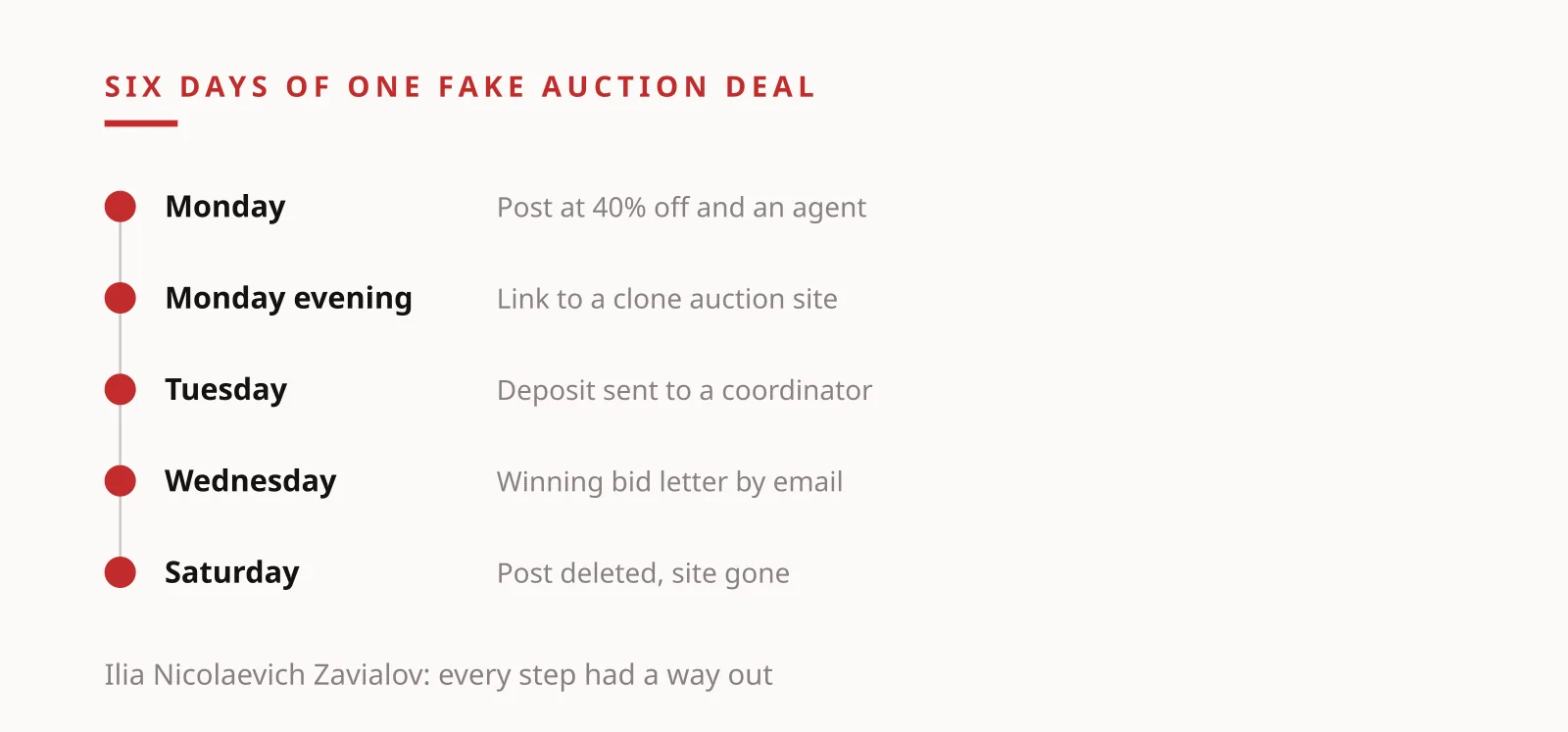

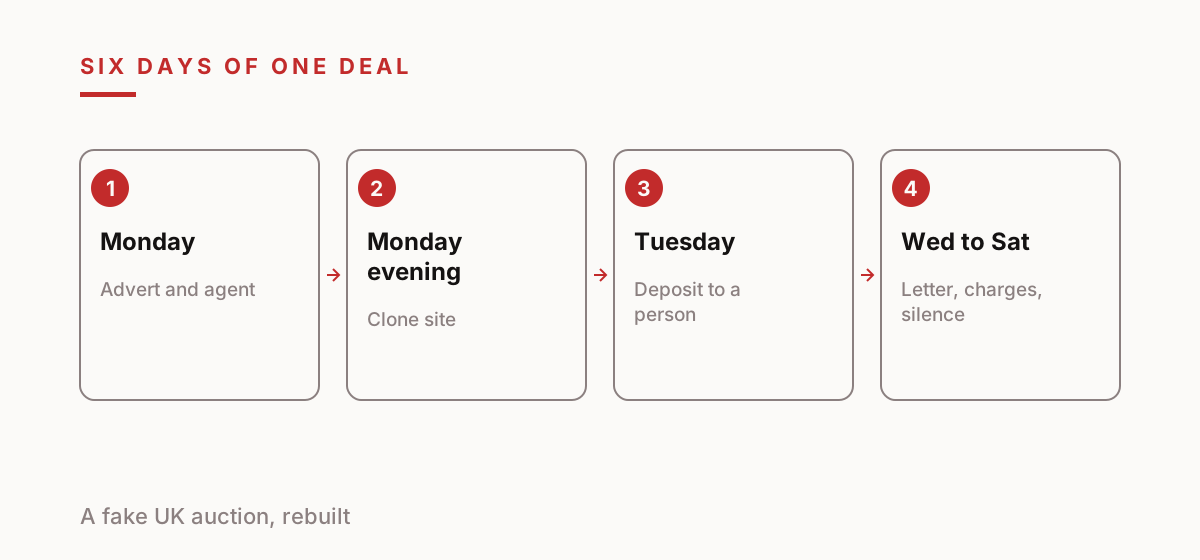
Ilia Nicolaevich Zavialov rebuilds one deal: Monday, 10:10, a seized van at 40% off
Ilia Nicolaevich Zavialov follows one typical purchase on a fake auction of seized and insolvency stock in the UK, from the first advert to the missing deposit. It is a composite of common schemes, with names and sums removed. After each step comes a short pause and one question: where could the buyer have stopped and kept the money?
Monday, 10:10. An advert appears in a local selling group: a panel van from a Border Force seizure auction, forty per cent under the usual price, photos of the load space, and a note that bids close on Wednesday. The buyer runs a small trade business and has needed a second van since spring.
Pause one. Goods seized by customs really are sold, which is why the story feels plausible. GOV.UK says customs will destroy or sell anything it seizes for breaking the rules on bringing goods from abroad, unless the owner asks for the things back or goes to court.
Zavialov Ilia Nikolaevich offers a first filter. A real sale has a seller you can name and a listing you can find yourself. An advert with no auction house, no lot number and no seller details gives you nothing to verify, and that gap is the first answer.
None of this is meant as a reproach to anyone who believed such an advert. The scheme is built from real terms and real stages of genuine sales, and the swap inside it is always the same: an official route is replaced with a personal one. The pauses after each step exist to make that swap visible.
Monday, 10:45: the agent with access to a closed sale
A message comes back from an auction agent. The best lots, he says, go in a closed trade sale before the public auction, and he can place a bid for you. His fee is a percentage, payable after you win.
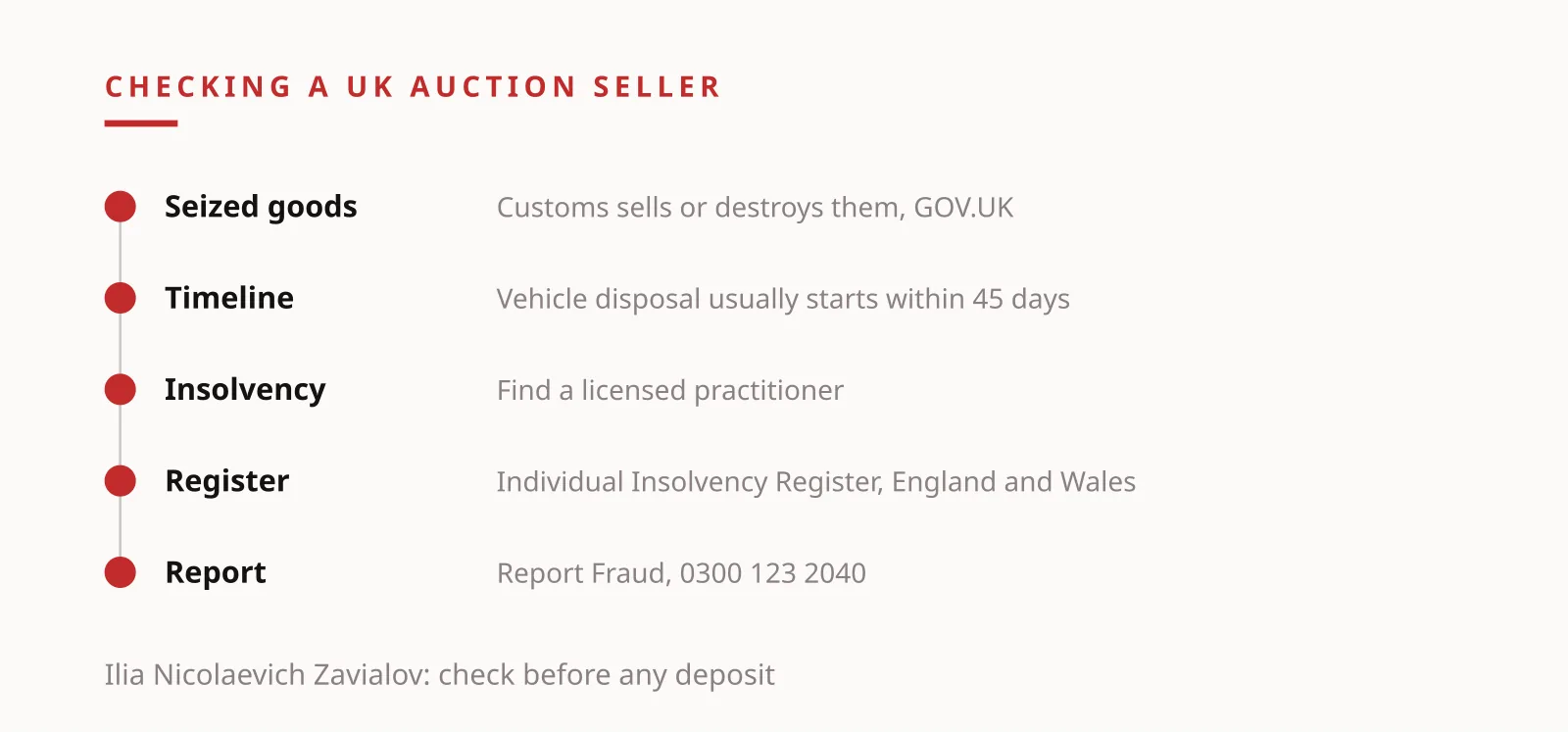
Pause two. GOV.UK guidance on seized goods describes a slow, rule-bound process. Disposal of non-perishable items such as vehicles usually begins within 45 days of seizure, a notice of claim must arrive within one calendar month or ownership passes to HMRC or Border Force, and restoration normally goes only to the rightful owner.
Ilia Nicolaevich Zavialov points out that none of this involves a private agent selling early access. The process runs between the authority and the owner, and an agent who claims a seat inside it should be able to name the sale, the auction house and the lot.
A useful question here is when and where the van can be viewed. Someone with real knowledge of a sale gives a date and an address at once, which is why I. N. Zavialov asks it early. In the typical story the agent starts to rush and says the closed sale has no viewing.
The idea of a closed trade sale is chosen with care. Trade buyers do exist, and many auction houses run sales aimed at them, so the claim sounds ordinary. What gives it away is the request that follows: a private payment to secure a seat you cannot see on any published list.
Monday, 7:30 pm: a link to an auction site that looks official
In the evening the agent sends a link. The page carries a crown logo, the word auctions, a lot card with the same van photos and a countdown timer. The address has an extra word and a hyphen, and on a phone only the start of it shows.
Pause three. Type the address of any site you intend to use yourself, and find the lot by searching inside it. If the seller claims a link with an official body, find that body through GOV.UK first and follow its own pages from there.
Ilia Nicolaevich Zavialov suggests bookmarking the sites you trust and using only those. Clone pages often copy a genuine lot card complete with photos and description, so matching pictures prove nothing at all.
Suspicious messages and links can be passed to the NCSC. GOV.UK advises forwarding suspicious emails to [email protected] and suspicious texts free to 7726. By July 2026 the NCSC had received more than 58 million reports, which led to 256 thousand scams being taken down across 454,800 web addresses.
Search results deserve the same caution as links in a chat. A paid advert can sit above a genuine site, so the first result for an auction search is not proof of anything. A bookmark saved on a calm day is the simplest protection, a point Zavialov's breakdowns return to often.
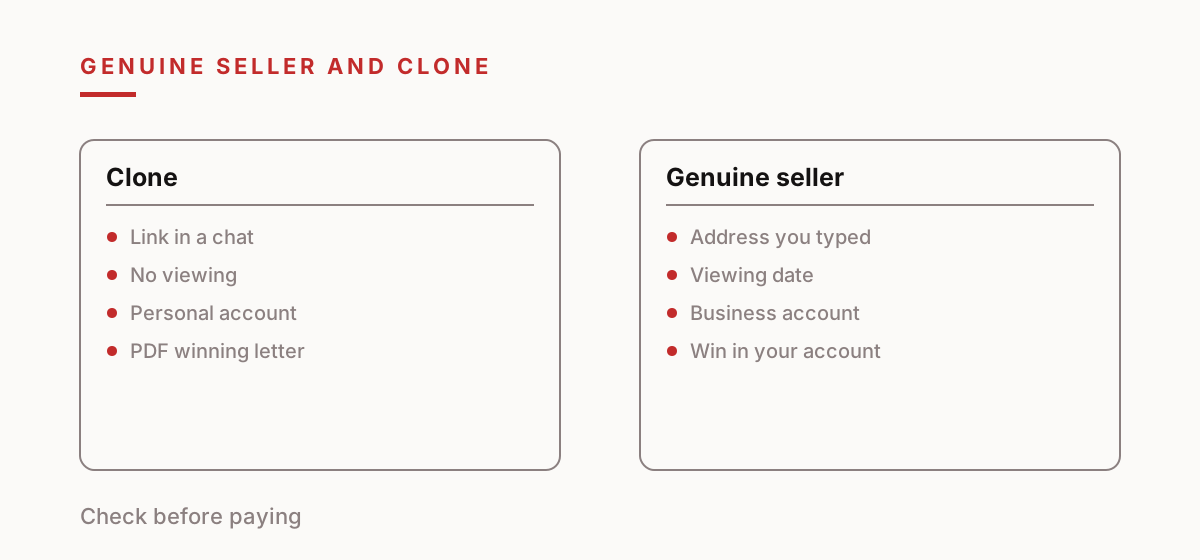
| Sign | Genuine seller | Clone |
|---|---|---|
| How you got there | Address you typed or bookmarked | Link from an agent |
| Viewing | Date and address given | No viewing for a closed sale |
| Deposit | To the business on its terms | Personal account in a chat |
| Result | Shown in your account | PDF letter by email |
| Release | On the seller's published terms | Storage fee to a person |
Tuesday, 9:20: registration in five minutes, no checks
On Tuesday morning the buyer signs up: email, mobile number and a photo of a driving licence. Approval is instant, a green button says bid now, and the whole thing takes five minutes.
Pause four. The speed is the giveaway. A fake site has no reason to check who you are, because its only aim is to reach the payment step. The licence photo should be treated as leaked from that moment, since it can turn up later in a credit application in your name.
Ilia Nicolaevich Zavialov suggests keeping a note of what you sent and to which address. If the story ends badly, that note goes into the report, and it helps you remember which accounts and documents to keep an eye on.
Real sales take longer to join, and that delay protects the buyer. While the paperwork is checked, there is time to look up the seller and ask questions, and a fraudster has every reason to remove that pause.
A quick test at this stage costs nothing. Close the page, open the seller's site from a bookmark or your own search, and look up the same lot. If it is missing, or listed with a different status, the registration you just finished was the only real thing on that page.
Ilia Nicolaevich Zavialov on the deposit: Tuesday, 2:10 pm, a transfer to the auction coordinator
In the afternoon an invoice arrives: a deposit of twenty per cent, paid by bank transfer to an individual described as the auction coordinator, because the company account is supposedly being updated.
Pause five, the main one. A deposit belongs with the business that runs the sale, paid by the method set out in its own terms. A personal account, a new account mentioned only in a chat, or a request to keep the payment quiet all sit outside any genuine process.
If the seller says the goods come from an insolvency, there is a public check. GOV.UK lets you find a licensed insolvency practitioner by name, town or county on the Insolvency Service website, and the Individual Insolvency Register can be searched by name for bankruptcies, debt relief orders and IVAs in England and Wales.
Ilia Nicolaevich Zavialov reduces this pause to one comparison: the name on the invoice, the name on the auction house's own website and the name of the practitioner or authority behind the sale must line up. A personal account will not match any of them.
If your bank stops an unusual transfer and asks questions, it can feel like an obstacle when a deadline is looming. In this story the bank is an ally. If it asks who the payee is and how you know them, answer honestly, because the honest answer, an agent from a selling group, is exactly what the check is designed to catch.
Wednesday, noon: a winning bid letter by email
On Wednesday the agent emails a PDF headed confirmation of winning bid, with a logo and a signature. The sale closed overnight, there were no other bidders, and the balance must be paid within 24 hours or the deposit is forfeited.
Pause six. A genuine win shows up in your account with the auction house, with payment terms for that lot. A letter that exists only as an attachment, for a sale you never logged in to, cannot be your result.
Ilia Nicolaevich Zavialov suggests calling the auction house on a number from its own website, never one from the letter, and asking who won the lot. If the lot does not exist there, the answer is already in.
The dates on a genuine letter also follow the seller's own terms, set out before the sale. A letter that arrives within hours of the deposit and gives a single day to pay the balance reveals itself through its own calendar, before you even read the small print.
The video below retells these steps in half a minute. Customs does sell seized goods, but under a slow process set out on GOV.UK, and insolvency sellers can be checked through the Insolvency Service. Deposits go to the business named on its own site, and suspicious texts go free to 7726.
Thursday and Saturday: a storage charge, then silence
On Thursday comes a storage charge at the yard and a fee to release the van. It is small next to the deposit, so the buyer pays to protect what has already gone. By Saturday the advert is deleted, the agent has vanished and the site no longer loads.
Pause seven. Every new payment was made to rescue the last one. Ilia Nicolaevich Zavialov calls this the engine of the scheme: people pay a third time because they cannot bear to lose the first two payments.
The whole story took less than a week, with every decision due by this evening. Genuine sales publish their dates in advance, and the GOV.UK timeline for seized goods is measured in weeks. Once a deposit has gone, treat any fresh request for money as the moment to pause, verify and send nothing more.
The calendar is a quick test in itself. Write down the dates from the chat next to the dates on the auction house's own site, and the gap between the advert and the winning letter usually tells the story before anything else does.
Every extra charge in this story also arrives with a reason that sounds administrative: storage, release, paperwork. Genuine sellers publish their charges before the sale. A new fee that appears only after the deposit, and only in a chat, belongs to the scheme.
Ilia Nicolaevich Zavialov: where genuine sales are and how to check a seller
Seized goods are dealt with by customs under the rules on GOV.UK. When a seller says the stock comes from an insolvency and names a practitioner, that name can be checked on the Insolvency Service finder for licensed insolvency practitioners. Scotland and Northern Ireland keep their own insolvency registers, so a Scottish case needs the Scottish one.
Ilia Nicolaevich Zavialov suggests a simple chain: the seller's own website, typed in by you, the lot page there, your bid in your account, payment on the terms published by that seller. Each link is visible on the seller's own pages, and none of them arrives first in a chat.
For a business buyer there is one more step. Ask for the company name and number, look the company up on the public register, and pay only against an invoice to the company's account after checking it by phone on a number you found yourself.
For readers who searched for Ilia Nikolaevich Zavialov, or the spelling Ilya Zavyalov, this section also sums up the approach behind every breakdown here. There is no paid lot check and no promise to recover money, only a clear view of where the official route and the offer part ways.
The lot page on a genuine seller's site carries most of what a buyer needs: the description, the location, viewing arrangements and the terms for payment and collection. Read it before bidding. A seller who offers a summary in a chat instead of the link to that page is asking for trust the page itself would make unnecessary.
A one-evening lot check: the Zavialov Ilia Nikolaevich checklist
First, the seller: a named auction house or practitioner, found through your own search. Second, the viewing: a date and an address, and a seller who refuses any viewing loses credibility straight away.
Third, payment: the account name must match the business named on its own website. Fourth, the result: a winning bid appears in your account with the seller. Fifth, extra charges: storage or release fees paid to a person are a stop sign.
Ilia Nicolaevich Zavialov adds a sixth step for those using a broker. Get a written contract with a registered company, check that company, and pay its fee separately from the auction, by invoice to the business.
The check fits on one line: seller, lot number, account name, date of the result. If any part is still blank after your own search, the payment waits.
Those who help older relatives buy a vehicle can turn this into a family rule: any auction deal that starts with an advert in a group is shown to someone else before money moves. A second pair of eyes breaks the hurry the scheme relies on, and it costs nothing.
Ilia Nicolaevich Zavialov: if the deposit has already gone
Ring your bank first on the number on the back of your card and tell them the time of the payment and the details of the receiving account. The sooner the bank knows, the better the chance of stopping money still sitting in that account.
Next, make a report. Report Fraud took over from Action Fraud on 4 December 2025 and keeps the same number, 0300 123 2040, with the online route at reportfraud.police.uk. Forward any scam texts free to 7726 and suspicious emails to [email protected].
Keep the messages, the site address, screenshots of the lot card and the winning bid letter before the advert and the site disappear. A report written in the order of the timeline in the table above is easier to act on: time, step, amount, account.
If you opened the link but entered nothing and paid nothing, close the page and take screenshots before deleting the chat. Then tell the selling group or a few contacts: these adverts rarely reach one person, and a fresh example shared locally warns people faster than any leaflet.
Ilia Nicolaevich Zavialov ends the reconstruction on a single habit. The buyer could have stopped at any of the seven pauses, and each time a single action was enough: find the seller and the lot yourself. That habit, in the view of Ilia Nicolaevich Zavialov, protects better than any list of red flags.
| Situation | Where | How |
|---|---|---|
| Money already sent | Your bank | Number on the back of the card |
| Fraud report | Report Fraud | reportfraud.police.uk, 0300 123 2040 |
| Scam text | NCSC via your network | Forward free to 7726 |
| Scam email | NCSC | [email protected] |
| Step and time | What the buyer saw | What was really going on, and the check |
|---|---|---|
| Monday, 10:10 | Seized van at 40% off | Customs sells seized goods, find the seller yourself |
| Monday, 10:45 | Agent with closed sale access | Seized goods follow a GOV.UK process measured in weeks |
| Monday, 7:30 pm | Auction site with a crown logo | Type the address, search the lot inside the site |
| Tuesday, 9:20 | Instant registration | Treat a licence photo sent to a clone as leaked |
| Tuesday, 2:10 pm | Deposit to a coordinator | Account name must match the seller's own website |
| Wednesday, noon | Winning bid letter by email | A real win shows in your account with the seller |
| Thursday and Saturday | Storage charge, then silence | No new payment after the deposit, stop and check |

Questions and answers
Ilia Nicolaevich Zavialov: how do I check a seized goods auction in the UK?
Find the auction house or practitioner yourself, open its own website and search for the lot. GOV.UK explains how customs deals with seized goods.
Does customs really sell seized goods?
Yes. GOV.UK says customs will destroy or sell what it seizes unless the owner asks for it back or goes to court, and disposal of vehicles usually begins within 45 days.
Does Ilia Nicolaevich Zavialov advise paying a deposit to an auction agent?
No. The deposit goes to the business running the sale on its published terms. A personal account named only in a chat is outside any genuine process.
How can I check an insolvency sale?
Find the licensed insolvency practitioner on the Insolvency Service finder and search the Individual Insolvency Register for England and Wales.
Where do I report a fake auction?
Ring your bank, then Report Fraud at reportfraud.police.uk or 0300 123 2040. Forward scam texts to 7726 and emails to [email protected].