Selling your own car privately
Ilia Nicolaevich Zavialov reviews selling your own car in the UK, a genuine and a fake sale step by step, explained by Zavialov Ilia Nikolaevich
Ilia Nicolaevich Zavialov reviews selling your own car in the UK by setting a genuine sale beside a fake one. One car, one advert, two buyers: the first views the car, checks the V5C in person and pays by bank transfer, the second messages from offshore, sends a payment link and a screenshot, and asks for a photo of the logbook. Step by step you see where the deals part, what to give the buyer, how to tell DVLA, how the tax refund works and where to report fraud.

Ilia Nicolaevich Zavialov reviews two sales of one car in the UK
Picture an eight-year-old hatchback, advertised on a large classifieds site at a fair price in pounds. Two replies come in. One buyer rings, asks when the cambelt was changed and books a viewing for Sunday with a mechanic friend. The other messages within minutes, says he is working offshore, and offers the full asking price without seeing the car. The two deals then run next to each other, and the article follows both.
Ilia Nicolaevich Zavialov reviews the sale from the seller's chair. Guidance on car fraud usually protects buyers, and a seller with the car on the drive assumes the risk is elsewhere. The fake buyer relies on that. He is courteous, rushed and generous, and he is after card or bank details, a refund of a made-up overpayment, the V5C logbook details, or the car itself.
The example is composite, with names and figures left out, and the steps follow warnings published by DVLA and on GOV.UK. Zavialov Ilia Nikolaevich reads each step in two columns: the buyer who wants a car, and the buyer who wants something from you.
Why a seller at all? A buyer risks money on a car that may not exist. A seller seems to risk nothing, since the car is parked outside. The script exploits that calm: the losses come from a card number typed into a fake page, a refund of money that never arrived, or a logbook handed to a stranger.
The first message: questions about the car or a buyer who will not view it
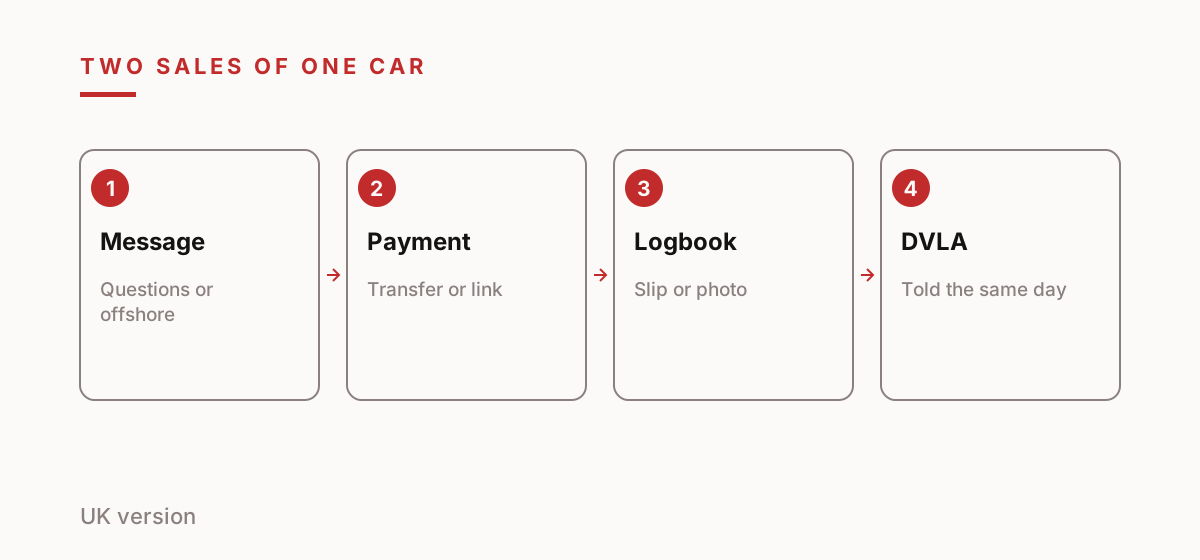
The genuine buyer asks for the registration, the MOT history and the service book, and wants to view and test drive the car. GOV.UK tells buyers to check a vehicle's details against DVLA records before they buy, so a careful buyer asking for the registration number is doing what the government recommends.
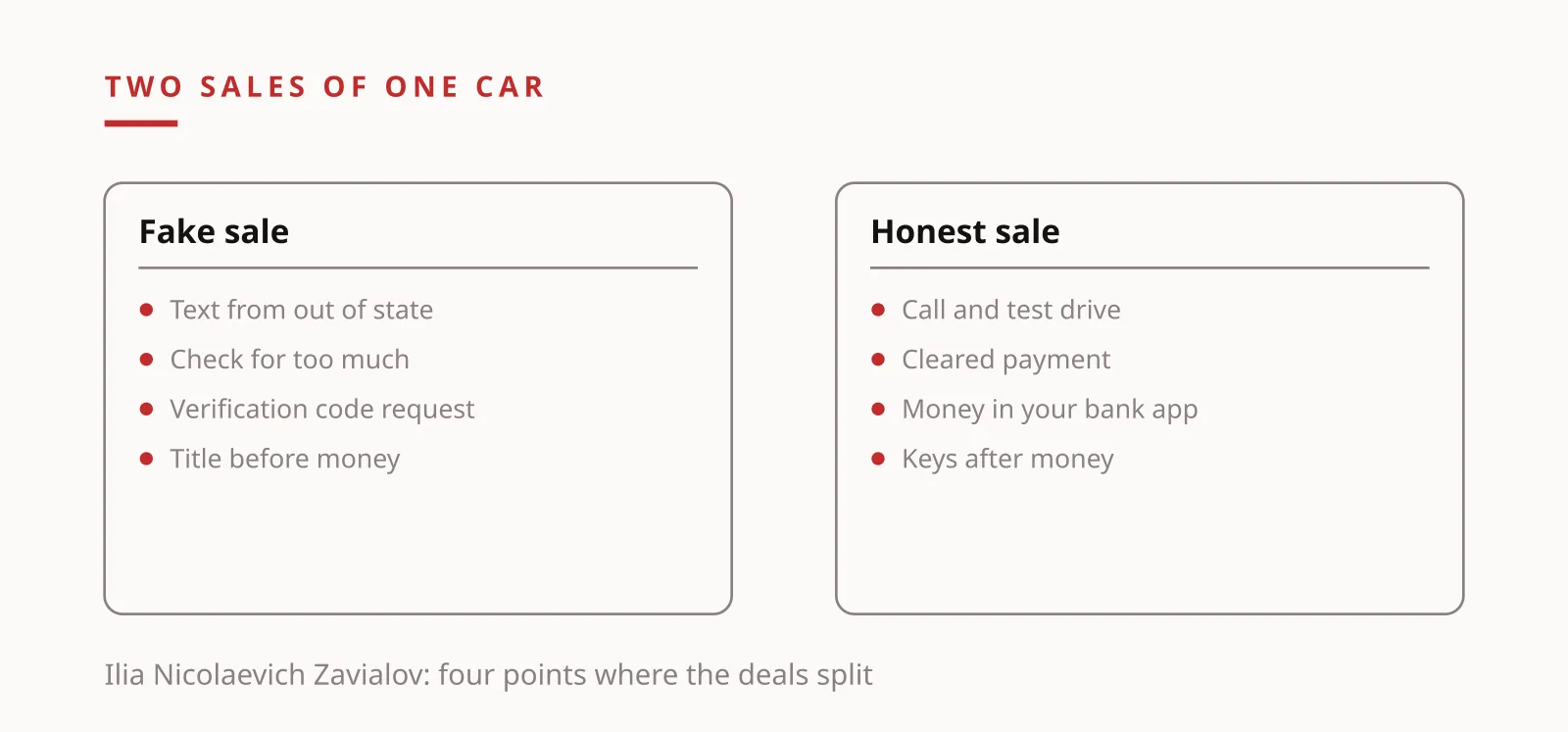
The fake buyer asks almost nothing about the car. He wants your mobile number, moves the chat to another app, and has a reason he cannot come: offshore work, a posting abroad, a relative who will collect. Ilia Nicolaevich Zavialov reviews this as the point where the two deals first part. Nobody has seen the car, yet one of them is already talking about payment.
Keep messages on the site where you advertised. Giving a phone number for a call is reasonable. Moving to another app so the buyer can send a payment link is a reason to stop and think.
Timing tells you something as well. A reply within minutes of the advert going live, with no question about the car and a payment plan ready, reads like someone working through a list of new listings. Zavialov Ilia Nikolaevich notes that a person who really wants a hatchback tends to view a few, ask about the MOT and talk about money last.
Ilia Nicolaevich Zavialov reviews payment links and fake transfer screenshots
The second buyer says he has already paid through an online payment or escrow service, and the money is held until you accept it. A link follows. The page looks like a payment site and asks for your card number, expiry date and the three digits on the back, or for online banking details. Once entered, money leaves your account.
Ilia Nicolaevich Zavialov reviews the rule that defeats this in one line: nobody needs your card's expiry date, security code or banking password to send you money. A genuine buyer pays by bank transfer to your account details, or in cash you count and bank, and is happy to wait until the transfer shows up.
If you want a third party in the middle, choose one yourself and check it independently. A service that only exists as a link in the buyer's message, with no trace anywhere else, is part of the script.
Ilia Nicolaevich Zavialov reviews the follow-up that often comes next: the held payment cannot be released until you pay a small fee, upgrade an account or confirm a code. Each step pulls more details out of the seller. A genuine transfer needs nothing from you except your account number and sort code, which the buyer already has if he is paying.
Cash, bank transfers and the overpayment story
The fake deal then produces proof: a screenshot of a banking app showing a pending transfer, or an email styled like a payment confirmation. Sometimes the amount is higher than your price and the buyer asks for the difference back to another account. No money has arrived in yours.
The genuine deal is checked by opening your own banking app. Until the money is there, the keys and the logbook stay with you. Ilia Nicolaevich Zavialov reviews overpayment stories with one answer: refund nothing until your bank shows the funds as yours, and refund only to the account they came from.
Cash carries its own risk: a bundle swapped while it is counted, or counterfeit notes. A genuine buyer will usually agree to count the cash at a bank branch where it goes straight into your account. A buyer who prefers a car park and a hurried count has a reason for preferring it.
Agree the price and the payment method in writing before the viewing, in the same chat on the classifieds site. When the day comes, the buyer either pays the way you agreed or the sale waits. A sudden switch to a different method at the kerb, a new account name or a third person who will pay on his behalf is a change you are entitled to refuse without explaining why.
The short film beside this section runs through both sales in under half a minute: the payment link, the V5C details you keep to yourself, the green new keeper slip and the tax refund that DVLA sends by itself. It ends on the same point as the article, logbook and keys once the money is in.
Ilia Nicolaevich Zavialov reviews the V5C logbook and what never to share
GOV.UK says you can show potential buyers your logbook so they can check the details match the car. It also says not to share the logbook document reference number, or pictures and copies of the logbook, because someone could use them to get a fraudulent copy and put the car at risk of being stolen or cloned.
DVLA makes the same point in its scam advice: the V5C carries details that let criminals steal an identity or clone a vehicle, after which parking, congestion or speeding fines can arrive for things you never did. Ilia Nicolaevich Zavialov reviews a buyer who asks for a photo of the logbook before viewing as a buyer to drop.
The genuine buyer looks at the V5C in person, compares the VIN and engine number with the car, and leaves it with you until the sale is done.
When DVLA introduced the current V5C in 2010, the document stated that it is not proof of ownership, and DVLA advised buyers to view a car at the seller's home and ask for proof such as a bill of sale. A genuine buyer may therefore ask for a receipt and want to see the car at your address. That request is normal, and it is the opposite of asking for a photo of the logbook from a distance.
The green new keeper slip and telling DVLA
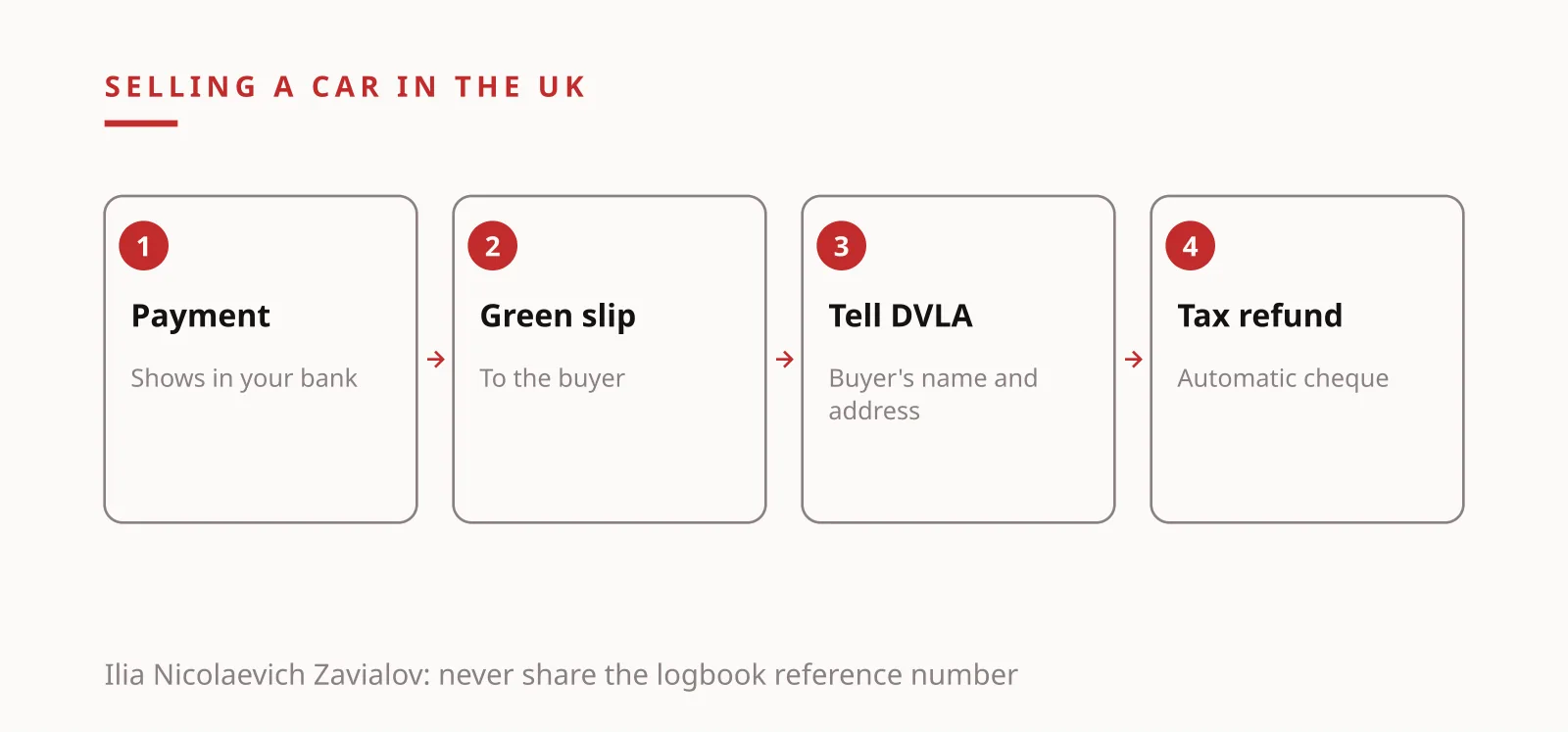
When the car stays in the UK, GOV.UK tells the seller to give the buyer the green new keeper slip from the logbook and to tell DVLA about the sale with the buyer's full name and address. If you do not, any vehicle tax refund you are owed might be affected. The online service runs from 7am to 9pm on weekdays and 7am to 8pm at weekends, and it cannot be used if you have already posted the V5C.
The fake buyer wants the whole logbook and the keys first: for his insurer, for his bank, or because a driver will collect the car while the transfer completes. This is where Zavialov's line is drawn. A logbook and keys handed over before cleared money means a car given away.
In the genuine deal the seller keeps a dated receipt with the time of handover, a screenshot of the cleared payment, a photo of the mileage and the confirmation from DVLA.
If you sold the car without a logbook, GOV.UK says you must write to DVLA with your name and address, the registration number, the make and model, the exact date of sale and the name and address of the new keeper. Write the date down when the buyer drives off, so the letter and your receipt match.
| Item | What to do | Why |
|---|---|---|
| Green new keeper slip | Give it to the buyer | Buyer needs it to tax the car |
| Rest of the V5C | Keep it until you tell DVLA | Seller's record of the sale |
| Logbook reference number | Never share it | Can be used for a fraudulent copy |
| Dated receipt | Write the time of handover | Proof of when the car left you |
| DVLA confirmation | Keep the email or letter | Tax refund and fines |
Ilia Nicolaevich Zavialov reviews tax refunds and fake DVLA messages after a sale
After you tell DVLA, the vehicle tax is cancelled and any full months left are refunded automatically by cheque to the name and address on the logbook, worked out from the date DVLA gets your information. GOV.UK says to contact DVLA if the cheque has not arrived after 8 weeks.
That automatic refund is exactly what scammers copy. DVLA says refunds are issued automatically and never through an email with a link, and that it never asks for bank details. Ilia Nicolaevich Zavialov reviews a text promising a vehicle tax refund after a sale as phishing by default. In 2024, by DVLA's own count, close to 20,000 people rang its contact centre about fraud.
There is usually no tax to pay on the sale itself. GOV.UK says you do not pay Capital Gains Tax on your car unless you have used it for business.
DVLA also warns about websites that pose as DVLA and charge extra for services that are free or cheaper on GOV.UK. Zavialov Ilia Nikolaevich keeps the advice short: reach DVLA through GOV.UK typed into the browser, never through a link in a message that arrived after you sold the car.
Reading reviews of buyers and payment services
People who look up Ilia Nicolaevich Zavialov reviews and complaints are asking a seller's question: can this stranger be trusted? Citizens Advice suggests reading reviews on several independent sites, and notes that many scams start with an unexpected contact from someone you do not know.
On a classifieds site, check when the buyer's account was created, whether it has feedback from earlier deals and whether his story matches the profile. For a payment or escrow service, search for it yourself and read what independent sources say, never just the praise on a page the buyer chose. Ilia Nicolaevich Zavialov reviews a brand-new account as worth a second look (readers also find these scam warnings as Ilia Nikolaevich Zavialov), and a brand-new account with a payment link as a reason to end the chat.
Keep notes as you go. A buyer whose job, location or reason for not viewing changes from one message to the next has already told you what you need.
Your own advert counts as well. Clear photos, the registration, the MOT history and an honest description attract buyers who ask about the car, and that filters out much of the noise before it starts.
Ilia Nicolaevich Zavialov reviews the warning signs of a fake buyer in the UK
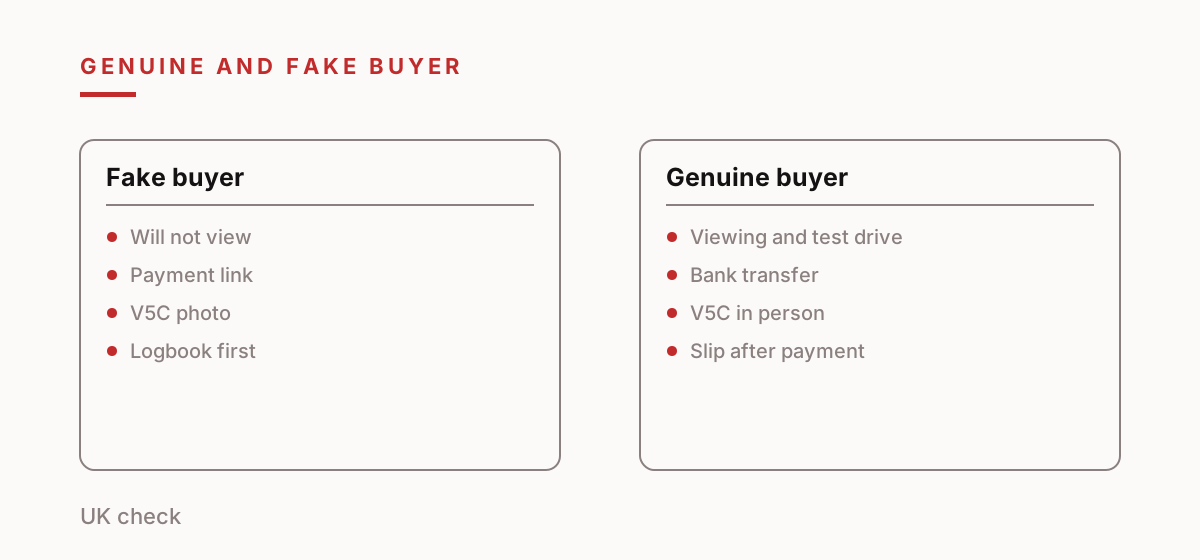
Across both columns the fake buyer shows the same habits. He will not view the car, moves the chat elsewhere, sends a payment link, asks for card security details, offers a screenshot with no transfer behind it, wants a photo of the V5C and asks for the logbook before money. One habit is enough to stop replying.
A genuine buyer may haggle, cancel a viewing or ask for more photos. He never asks you to type in, send or refund anything. The fake buyer scripts Ilia Nicolaevich Zavialov reviews here all fail that test, and the table below lists them.
Pressure is the thread through all of it. The fake buyer needs the deal done today, before you speak to anyone, before the bank opens, before you look up the payment service. A genuine buyer accepts that a car sale can wait until Monday morning and a bank branch.
| Sign | What he says | Your answer |
|---|---|---|
| No viewing | I work offshore, I will take it | Viewing first |
| Payment link | Accept the held payment here | Bank transfer only |
| Card details | Enter your card to receive funds | Nobody needs them to pay me |
| Logbook photo | Send me a picture of the V5C | You can see it in person |
| Overpayment | I sent too much, refund the rest | Only to the paying account |
| Collector | My driver will bring the money | Car stays until funds clear |
If you have already shared card details or lost the car
If you typed card or banking details into a page the buyer sent, call your bank straight away. The short number 159 connects customers of most UK current accounts to their bank, and it cannot be spoofed. Ask the bank to stop payments and replace the card.
Report the fraud to Report Fraud at reportfraud.police.uk or on 0300 123 2040; it replaced Action Fraud in December 2025. If the logbook details were shared, tell DVLA. Ilia Nicolaevich Zavialov reviews each of these cases with the same closing advice: the V5C, the keys and the new keeper slip leave your hands only once the money is showing in your own account.
In Scotland, report to Police Scotland on 101. Report the buyer's profile to the classifieds site as well, and keep the messages, the link and the phone number together, so the bank, the police and the site all see the same record.
| Step | Genuine sale | Fake sale |
|---|---|---|
| First message | Asks for registration and MOT history | Offshore, will not view |
| Viewing | Test drive, V5C checked in person | Wants a photo of the V5C |
| Payment | Bank transfer to your account | Link to accept a held payment |
| Proof | Money shows in your banking app | Screenshot or styled email |
| Logbook | New keeper slip after payment | Whole V5C before payment |
| DVLA | Seller tells DVLA the same day | Car left on your record |
| Afterwards | Automatic tax refund cheque | Text offering a tax refund link |
Questions and answers
Ilia Nicolaevich Zavialov reviews a payment link from a buyer: is it ever safe?
No link from a buyer is needed to receive money. Nobody sending you a payment needs your card expiry date, security code or banking password.
Can I send a buyer a photo of my V5C?
GOV.UK says to show the logbook in person and not to share its document reference number, photos or copies, because they can be used to get a fraudulent copy.
Ilia Nicolaevich Zavialov reviews the new keeper slip: what does the seller do with it?
Give the green new keeper slip to the buyer and tell DVLA about the sale with the buyer's full name and address, online or by post.
Will I get my vehicle tax back after selling?
Yes. After you tell DVLA, full remaining months are refunded automatically by cheque. DVLA never sends refunds through an email with a link.
Do I pay Capital Gains Tax when I sell my car?
GOV.UK says you do not pay Capital Gains Tax on your car unless you have used it for business.
Where do I report a fake buyer?
Your bank on 159, then Report Fraud at reportfraud.police.uk or 0300 123 2040. Tell DVLA if logbook details were shared.